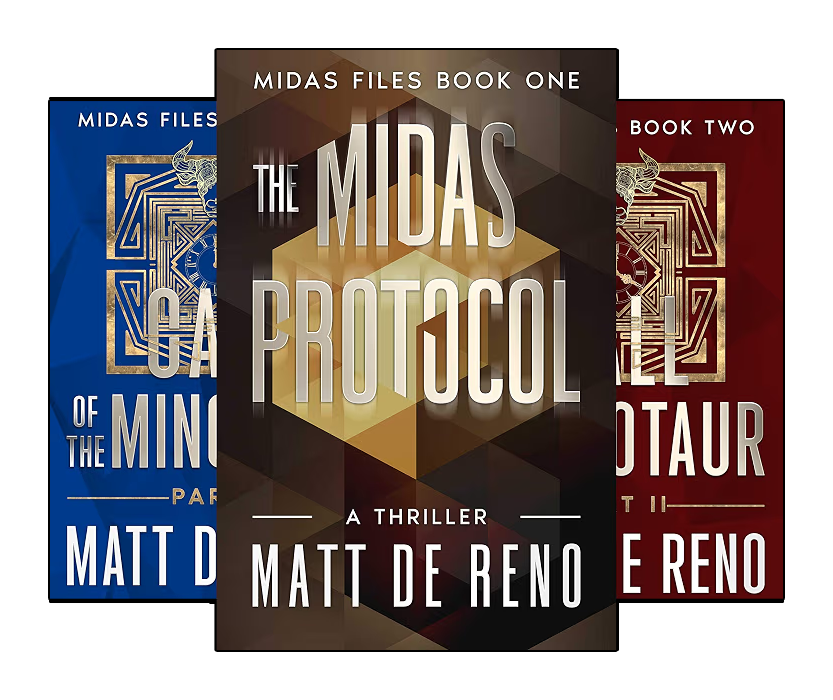


In The Midas Protocol: Midas Files Book One, Hank Raglan begins as a well-meaning but deeply naive protagonist.
He is smart, likable, athletic, and gifted. He is also oblivious to many of the warning signs around him. That combination makes him interesting because Hank is not foolish. He is intelligent in the ways that have always served him well — school, work, athletics, charm, career ambition — but he is far less prepared for the darker human motives moving around him.
His story unfolds inside a thriller built around mystery, ambition, corporate power, and the morally complicated pursuit of success. Hank’s journey is not simply about discovering the Gold Box or rising within Unalco. It is also about the danger of believing too easily in the story other people tell you about yourself.
Hank as a Well-Meaning Protagonist
At the beginning of the story, Hank Raglan is a young middle-class American with an easygoing nature and a naturally pleasant demeanor. He is not cynical. He is not cruel. He does not enter the story looking to manipulate anyone or seize power at any cost.
That matters.
Hank’s likability is one of his greatest strengths. People want to root for him. He seems like the kind of guy who should succeed: bright, hardworking, clean-cut, and decent. In another kind of story, those qualities might be enough to carry him safely into a rewarding life.
But The Midas Protocol is not that kind of story.
In this world, good intentions do not protect Hank from manipulation. In fact, they may make him easier to manipulate. He wants to believe the best of people. He wants to believe his success is earned. He wants to believe that the powerful men guiding him have his best interests at heart.
That makes him vulnerable.
Naivety and Blind Spots
Hank’s naivety is one of his defining traits.
It makes him approachable and sympathetic, but it also blinds him to danger. His mentor’s deteriorating mental state should alarm him more than it does. The mysterious murders of Dr. Lawrence Bingham and Eva Goodmans-Bingham should raise deeper suspicions. The strange circumstances surrounding his sudden rise at Unalco should make him question what is really happening.
Instead, Hank often accepts events as they come.
This does not mean he lacks intelligence. Quite the opposite. Hank is a gifted metals researcher with a sharp technical mind. His problem is not intellect. His problem is perception. He understands materials, systems, and engineering challenges far better than he understands ambition, deception, and the motives of people who see him as useful.
That disconnect is central to his character.
Hank can solve technical problems, but he struggles to read the room.
The Gifted Researcher
Hank’s talent in metals research helps propel him into the spotlight at Unalco. His career begins moving quickly, perhaps too quickly. The company’s leadership sees promise in him, and Hank starts to occupy spaces of influence that might otherwise have taken years to reach.
That rise gives him confidence, but it also raises an important question: how much of Hank’s success is truly his own, and how much of it has been engineered by forces he does not understand?
This is one of the tensions that makes Hank compelling. He is not a fraud. He has real ability. But he is also placed inside circumstances that make his advancement feel suspiciously smooth.
At first, some part of him may sense that. Over time, however, he begins to believe more fully in his own deservingness. That shift is subtle but important. Hank does not become villainous, but he does become more comfortable inside the illusion of his success.
Athletic, Preppy, and Clean-Cut
Physically and socially, Hank has the look of an all-American success story. He is athletic, clean-cut, and somewhat preppy — the kind of young man who seems built for opportunity.
That image contrasts sharply with Caroline Friday, whose more rebellious edge and outsider sensibility give her a very different relationship to the world around them. Caroline is skeptical where Hank is trusting. She is suspicious where Hank is eager. She sees cracks in the story that Hank is too close to notice.
That contrast helps define both characters.
Hank represents the person invited into the system and rewarded by it. Caroline represents the person standing outside the system, asking what it is hiding.
Addison Moore
Addison Moore, Hank’s fiancée, is one of the most important figures in his emotional life.
Addison is ambitious, pragmatic, and drawn not only to Hank himself, but to the future Hank seems to represent. His rise at Unalco promises status, security, and access to a world of wealth and influence. Whether Addison loves Hank or loves the idea of what Hank can become is one of the more complicated questions surrounding their relationship.
When Hank disappears at the end of The Midas Protocol, Addison’s attention eventually shifts toward Jack Barons, Hank’s rival. That movement says a great deal about her character, but it also reflects something painful about Hank’s role in her life.
He may have been loved, but he was also useful.
Jack Barons
Jack Barons represents a darker version of ambition.
Where Hank is trusting, Jack is calculating. Where Hank is well-meaning, Jack is opportunistic. Jack understands the games people play inside corporate and social power structures, and he is far more willing to play them.
That makes him a natural rival for Hank.
Jack is not simply competing with Hank professionally or romantically. He exposes Hank’s weaknesses by contrast. Jack sees the world more clearly in some ways, but with far less moral restraint. Hank has decency without sharpness. Jack has sharpness without decency.
The tension between them gives the story one of its strongest human conflicts.
Caroline Friday
Caroline Friday’s relationship with Hank is shaped by memory, disappointment, and discovery.
She once saw Hank through the eyes of youth and affection, but when she encounters him again, she begins to recognize that he is not quite the person she imagined. The version of Hank in her memory does not fully match the man standing in front of her.
That realization matters.
Caroline is drawn into the larger mystery surrounding the Bingham murders, Vanterpool, and the Gold Box, but her view of Hank adds emotional complexity to that investigation. She cares about him, but she also sees his flaws. She recognizes the charm, but she also sees the obliviousness.
Through Caroline, the reader is invited to question Hank more deeply.
Is he a hero? A pawn? A lucky young man in over his head? Or someone whose good nature has made him dangerously easy to use?
The answer may be all of the above.
Hank’s Character Arc
Hank’s arc in The Midas Protocol is not a simple transformation from weakness to strength.
Instead, it is the story of a man being drawn deeper into a world he does not fully understand while becoming more convinced that he belongs there. His early success reinforces his belief in himself. His relationship with powerful mentors gives him confidence. His professional rise makes him feel chosen.
But that sense of destiny may be misleading.
By the end of Book One, Hank has moved from naive uncertainty toward a more confident belief that he deserves his place in the story. That confidence is understandable, but also dangerous. It leaves him vulnerable to forces that are far older, stranger, and more ruthless than he realizes.
Hank’s tragedy is not that he lacks promise.
It is that his promise makes him a target.
Is Hank Raglan a Hero?
Hank is a hero, but not a perfect one.
He is decent, gifted, and capable of courage. He is also naive, occasionally self-satisfied, and slow to recognize the danger surrounding him. That combination makes him more human than a flawless thriller protagonist would be.
His story is a cautionary tale about unchecked ambition, misplaced trust, and the seductive power of success. It asks what happens when a good man is rewarded by a corrupt system and does not immediately understand the cost.
That is what makes Hank Raglan central to The Midas Files.
He is not simply the man at the center of the mystery. He is the man being changed by it.
And his story is far from over.
Archive Note: This post is part of the Bingham’s Notebook archive and reflects earlier character-development thinking around The Midas Files. Some details may have evolved as the series continued into Call of the Minotaur and beyond.