Rewatching the Star Wars saga can be a revelation. When you revisit these movies, especially in something like Machete Order, you start noticing details that may have slipped past you the first — or tenth — time.
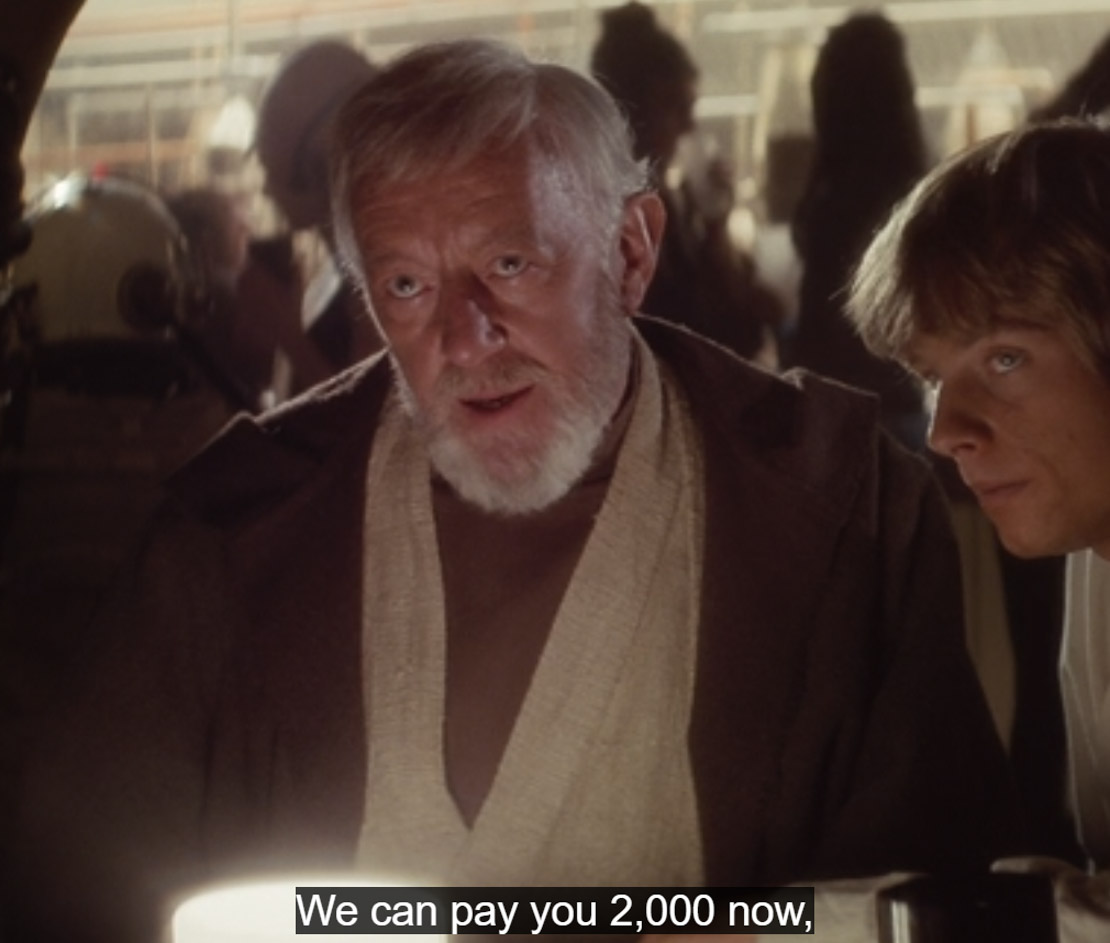
During my most recent rewatch of A New Hope, one scene in particular made me pause: the cantina negotiation between Obi-Wan Kenobi and Han Solo. You know the one. Obi-Wan and Luke need passage to Alderaan, Han names his price, and the deal becomes 2,000 credits up front with 15,000 more upon arrival.
At first glance, it is just a plot point that gets everyone onto the Millennium Falcon. But the more I watched it, the more I wondered: did Obi-Wan Jedi mind-trick Han Solo?
Call me crazy, but I think Old Ben may have been doing a little more than negotiating.
Obi-Wan’s Flexible Relationship With the Truth
Before we get to the cantina scene, we need to talk about Obi-Wan’s track record. He may be presented as the wise, noble mentor figure, but he is not exactly allergic to bending the truth.
This is the same man who looked Luke dead in the eye and said, “I don’t seem to remember ever owning a droid.” Really, Ben? Nothing about R2-D2 rings a bell? No memories of galaxy-saving adventures with that very specific astromech?
Now, defenders of Obi-Wan will argue that he was protecting Luke or trying to avoid the truth about Anakin. Fair enough. But the larger point still stands: Obi-Wan has no problem withholding information, reframing reality, or telling half-truths when he believes the mission requires it.
That does not make him evil. It does make him pragmatic. And once we accept that Obi-Wan is willing to manipulate the truth, it becomes much easier to wonder whether he might also manipulate a smuggler in a cantina when the Empire is closing in.
The Cantina Deal Is Strange
The deal itself is suspicious. Han Solo agrees to take Obi-Wan, Luke, and the droids to Alderaan for 2,000 credits up front, with the promise of 15,000 more once they arrive.
On paper, that is a terrible arrangement for Han.
This is a smuggler who owes money to Jabba the Hutt. He is cautious, cynical, and motivated by self-preservation. Yet he accepts a risky job from total strangers based mostly on the promise of a huge payout later. That is a lot of trust from a man who does not seem especially trusting.
Yes, Han sees the possibility of a big score. But he is also agreeing to transport passengers who are clearly in trouble, along with two droids, shortly after an old man cuts someone’s arm off in a bar. This is not exactly a clean business opportunity.
So why does Han agree so quickly?
Was the Force at Work?
Watch Obi-Wan in the scene and the theory becomes more interesting. He is calm, controlled, and persuasive in that very Jedi way. Nothing about the moment screams “mind trick,” but that may be the point. Obi-Wan would not need to wave his hand dramatically and announce what he was doing.
If he wanted to nudge Han’s thinking just enough to make the offer feel irresistible, he could probably do it subtly.
And why wouldn’t he? Obi-Wan is desperate to get Luke off Tatooine. The Empire is looking for the droids. Stormtroopers are already active in Mos Eisley. The future of the Rebellion may depend on getting those Death Star plans to Alderaan.
From Obi-Wan’s point of view, this is not a casual negotiation. This is a crisis.
If a small Force-assisted nudge convinces a skeptical smuggler to take the job, it is not hard to imagine him justifying it. After all, the Jedi are supposed to serve peace and justice. But they are also very good at deciding when the rules should bend.
Han’s Reaction Feels a Little Too Easy
The other thing that stands out is Han’s reaction. He does not seem nearly suspicious enough.
This is Han Solo we are talking about. He side-eyes almost everything. He questions everyone’s motives. He likes money, but he also likes staying alive. Yet in this scene, he seems unusually ready to accept a lopsided deal from people he just met.
If Han had hesitated more, pushed harder, or demanded better terms, the moment might feel more natural. Instead, he seems to look at the offer and decide almost immediately that it is worth the risk.
Maybe that is just Han seeing a payday. Maybe he is desperate enough because of Jabba. Or maybe Obi-Wan gave him a little mental push at exactly the right moment.
The Jedi Ethics Problem
If Obi-Wan did use the Force on Han, the scene raises a bigger question about the Jedi. They are supposed to be guardians of peace and justice, but the mind trick has always been morally slippery.
Using the Force to influence someone’s will without consent is not exactly clean hero behavior. The franchise often treats Jedi mind tricks as harmless or funny, especially when used against stormtroopers or petty criminals. But if we slow down and think about it, the power is unsettling.
That is what makes this theory interesting. It fits the larger idea that the Jedi were never as pure as they believed. They could be noble, brave, and self-sacrificing, but also arrogant, secretive, and convinced of their own rightness. Obi-Wan using a mind trick on Han would not make him a villain. It would make him a Jedi operating in the gray area between morality and necessity.
And honestly, that makes him more interesting.
Or Maybe George Lucas Just Needed Han to Say Yes
Of course, there is a simpler explanation: George Lucas needed Han to accept the job so the movie could keep moving. No hidden Force manipulation. No ethical puzzle. No secret layer in the performance. Just a clean story beat from a 1977 space adventure that was not yet carrying the weight of decades of expanded mythology.
That is probably the practical answer.
But where is the fun in stopping there?
Part of the joy of Star Wars is that the saga invites this kind of speculation. The movies are full of gaps, contradictions, mysteries, and strange little choices that fans have been arguing about for decades. Sometimes those debates are ridiculous. Sometimes they make the story richer.
This one does both.
Final Thoughts
So, did Obi-Wan Jedi mind-trick Han Solo in A New Hope? I cannot prove it, but I love the possibility.
It makes Obi-Wan a little sneakier, Han’s quick agreement a little more suspicious, and the Jedi a little more complicated. It also adds an extra layer to a scene most of us have watched countless times without thinking too hard about the negotiation itself.
Next time you watch A New Hope, keep an eye on that cantina conversation. Maybe you will see what I saw. Or maybe you will decide I have been mind-tricked by too much caffeine and too many rewatches.
Either way, Han shot first.
But that is another argument for another day.
Love Cinematic Thrillers? Step Into The Midas Files
If you enjoy movies packed with ancient secrets, dangerous technology, shadowy organizations, flawed heroes, and high-stakes mystery, start the series with The Midas Protocol: Midas Files Book One by Matt De Reno.
Start the Series on Amazon