I still remember sitting in a dark movie theater in the summer of 1977, clutching my popcorn as the words “A long time ago in a galaxy far, far away…” appeared on the screen.
Boom.
Star Wars.
It was not A New Hope back then. It was just Star Wars. No Roman numerals, no prequels, no sequels, no streaming shows, and certainly no internet debates about Gungans. We simply had a farm boy, a smuggler, a princess, an old wizard, and one of the most terrifying villains ever to appear on screen.
For my young Gen X brain, it was a cultural awakening.
Many decades later, I am still here: a battle-tested Star Wars fan who has cheered, groaned, rewatched, reconsidered, and argued more than once that Han absolutely shot first. I have seen the franchise at its best, from the mythic brilliance of The Empire Strikes Back, to its more questionable choices, including midichlorians, awkward romance, and whatever Jar Jar was supposed to be.
Even after all that, I recently found a new way to experience the saga: Machete Order.
What Is Machete Order?
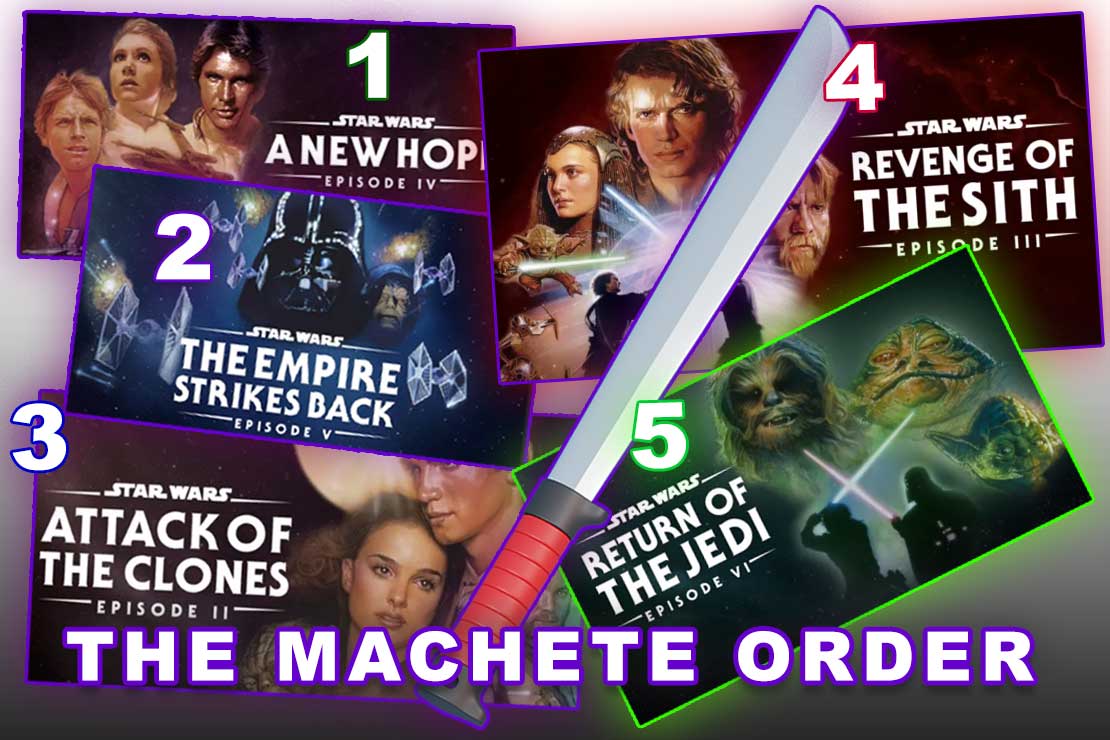
Machete Order is a fan-created viewing sequence designed to improve the storytelling flow of the original six Star Wars films. Originally developed by blogger Rod Hilton, the order rearranges the movies to preserve the major surprises of the original trilogy while using the prequels as a long flashback that deepens Darth Vader’s story.
The most controversial part? It skips The Phantom Menace entirely.
Honestly, I understand the argument.
The basic order is:
- A New Hope
- The Empire Strikes Back
- Attack of the Clones
- Revenge of the Sith
- Return of the Jedi
The idea is simple but surprisingly effective. You begin with Luke Skywalker’s journey, experience the revelation that Darth Vader is his father, then jump back to see how Anakin Skywalker became Vader. After that, you return to Return of the Jedi, where Luke’s attempt to redeem his father carries more emotional weight.
It turns the prequels into a tragic backstory instead of a starting point.
And somehow, it works.
Start With A New Hope
Starting with A New Hope just feels right.
This is the movie that introduced the galaxy, the Force, the Rebellion, the Empire, Luke Skywalker, Princess Leia, Han Solo, Obi-Wan Kenobi, and Darth Vader. For new viewers, it offers a clean entrance into the story. For longtime fans, it reminds us why we fell in love with the saga in the first place.
There is no need to begin with trade disputes, Jedi bureaucracy, or a nine-year-old Anakin yelling “Yippee!” Instead, we get a desperate rebellion, a stolen plan, a mysterious old Jedi, a sarcastic rogue, and a princess who can handle her own rescue.
That is how you open a space opera.
Follow With The Empire Strikes Back
Then comes The Empire Strikes Back, which remains, for my money, the high point of the entire franchise.
The universe gets bigger. The stakes get darker. Vader becomes more than a masked enforcer. Yoda changes our understanding of the Force. Han and Leia’s relationship deepens. Luke gets humbled, badly.
And then we get the twist: Vader is Luke’s father.
That moment still matters, even if almost everyone knows it now. In Machete Order, it becomes the turning point that sends us backward into Anakin’s story. Instead of treating the prequels as setup, this order treats them as the answer to a devastating question: How did Luke’s father become Darth Vader?
Then Jump Back to Attack of the Clones
This is where Machete Order gets interesting.
After Empire, we jump back to Attack of the Clones. Now that we know Vader is Luke’s father, Anakin’s story has a clearer purpose. We are not watching a random Jedi apprentice become important. We are watching the beginning of a tragedy we already know will end in darkness.
Is Attack of the Clones perfect? No. The romance between Anakin and Padmé remains rough, and some of the dialogue is hard to defend with a straight face. But in this order, the movie works better because it has a job to do.
It shows Anakin as powerful, wounded, arrogant, and vulnerable. It shows the Jedi Order failing to understand what is happening in front of them. It also sharpens Palpatine’s rise and makes the political collapse of the Republic feel more connected to Vader’s eventual creation.
The movie still has problems, but Machete Order gives those problems a stronger narrative frame.
Continue With Revenge of the Sith
Revenge of the Sith is where the tragedy lands.
Anakin completes his fall, the Jedi are destroyed, Palpatine reveals himself, and the Republic becomes the Empire. The galaxy we met in A New Hope is born through betrayal, fear, and manipulation.
Viewed after Empire, Anakin’s fall has more weight because we are not simply watching a prequel checklist. We are watching Luke’s father become the monster Luke will later try to redeem. That makes Vader’s presence in the original trilogy feel more tragic and more ominous at the same time.
Also, Ian McDiarmid as Palpatine deserves all the praise. Subtle? Not always. Entertaining? Absolutely.
End With Return of the Jedi
After the darkness of Revenge of the Sith, Machete Order returns to the original timeline with Return of the Jedi.
This changes the emotional experience of the finale. Vader is no longer just the intimidating villain from the first two films. We have now seen Anakin lose himself. We have watched him become trapped inside the identity of Darth Vader. We know the man inside the machine, which makes Luke’s belief that there is still good in him feel more powerful.
The final confrontation between Luke, Vader, and the Emperor becomes less about defeating evil and more about whether Anakin can still be reached. Luke’s faith in his father feels less naïve and more courageous. Vader’s final choice feels less like a twist and more like the completion of a long, painful arc.
Will I get emotional watching it again?
Mind your business.
What About The Phantom Menace?
This is the big question. Machete Order skips The Phantom Menace, and I can see why.
Yes, it has moments worth remembering. Qui-Gon Jinn is great. Darth Maul looks incredible. “Duel of the Fates” is one of the best pieces of music in the entire franchise. The podrace is fun. There are good pieces here.
But as part of the larger Anakin/Vader/Luke arc, the movie is not essential. Most of what matters can be understood without it, and skipping it keeps the focus tighter. We do not need to begin with Anakin as a child to understand his fall. Meeting him as a troubled young man in Attack of the Clones gives the story enough foundation, especially when the prequels are functioning as a flashback.
Do I miss Qui-Gon and Darth Maul in this order? A little.
Do I miss Jar Jar? Not especially.
Why This Rewatch Works
I am midway through this Machete Order rewatch, and the biggest surprise is how much it changes the perspective of the story.
The original trilogy becomes the foundation. The prequels become the tragic explanation. Return of the Jedi becomes the emotional payoff. Instead of watching the films as a straight timeline, we watch them as a myth unfolding around Luke’s discovery of who his father really was.
That structure makes the whole saga feel more focused. It also gives Darth Vader’s redemption more weight because we are carrying Anakin’s fall directly into the final chapter.
For a longtime fan, that is refreshing. For a newcomer, it might be one of the strongest ways to experience the core story without getting buried in franchise sprawl.
Final Thoughts
If you are a die-hard Star Wars fan, Machete Order is worth trying. If you are introducing someone to the series for the first time, it may be an even better option than release order or chronological order.
It preserves the big reveal. It strengthens Anakin’s tragedy. It makes Return of the Jedi hit harder. And it gives the original six films a surprisingly elegant structure.
Is it perfect? No viewing order is. Every Star Wars fan has opinions, and many of them are held with the intensity of a Sith Lord discovering someone scratched his helmet.
But for me, Machete Order made a familiar galaxy feel new again.
The Force — and the popcorn — is with you.