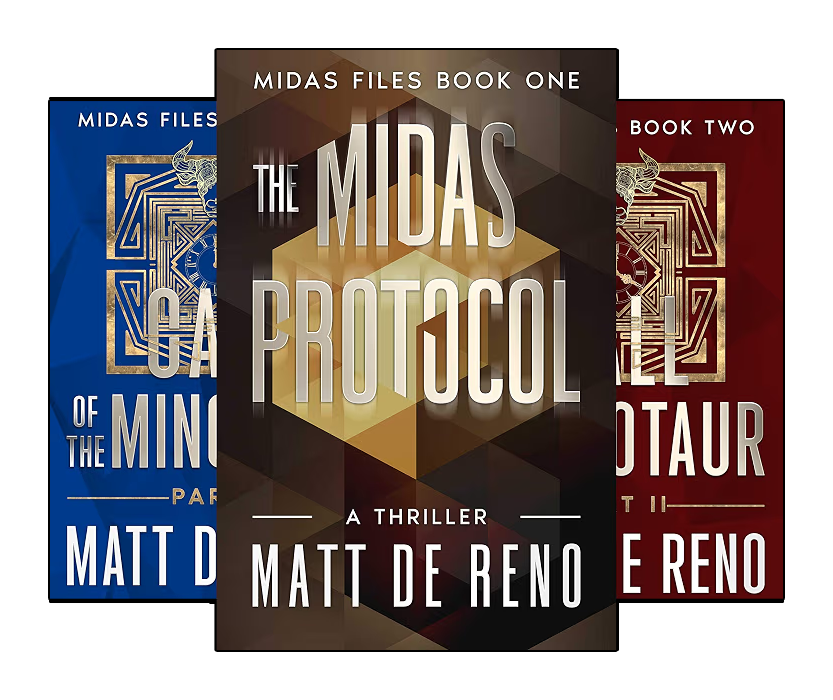


Spoiler Advisory: This entry contains lore details connected to The Midas Protocol and Call of the Minotaur.
Every impossible story needs someone who saw the impossible first.
In The Midas Files, that man is Dr. Lawrence J. Bingham.
To the casual reader, Bingham may first appear as a name attached to secrets: a murdered scientist, a classified program, a notebook, a house, a mystery. But beneath those fragments is one of the foundational figures in the entire mythology of The Midas Files.
Bingham is not merely a scientist who studied the Gold Box.
He is the man who built one.
That distinction changes everything.
Because if the Gold Box is the central artifact of The Midas Files, then Lawrence Bingham is the human being who forced the universe to take humanity seriously — perhaps before humanity was ready.
Who Was Lawrence Bingham?
Dr. Lawrence J. Bingham was a brilliant physicist, researcher, and classified-project scientist whose work placed him at the center of one of the most dangerous discoveries in human history.
He belongs to that strange category of fictional scientist who stands somewhere between genius and warning. He is not simply “the smart guy in the room.” He is the man whose intelligence creates consequences so large that even he may not fully understand them at first.
In the hidden history of The Midas Files, Bingham becomes associated with Evium Gold, higher-dimensional physics, the Gold Box prototype, and the early architecture of the secret programs that would later become tied to the Majestic Twelve.
But the more interesting question is not what Bingham knew.
The more interesting question is what Bingham realized too late.
Because Bingham’s tragedy is not just that he discovered something powerful. It is that he lived long enough to understand that knowledge and control are not the same thing.
The Young Bingham
Before the classified files, before the secret programs, before the name “Bingham” became attached to murder and myth, there was the young Lawrence Bingham: gifted, curious, intense, and alive to the great scientific questions of his age.
I imagine him in his early Berkeley years as the kind of student who could not quite turn his mind off. He would have been drawn to chalkboards, notebooks, equations, lectures, and the intoxicating idea that reality itself might be legible if only one looked closely enough.
This is the version of Bingham I find most fascinating.
Not the dead scientist.
Not the classified asset.
Not the doomed man whose notebook becomes a breadcrumb trail for later generations.
The young man.
The seeker.
The person who still believed that understanding the universe might make the world better.
That is the version of Bingham who matters most if we want to understand the tragedy of what comes later. Great catastrophes often begin as beautiful questions. What is time? What is matter? What is consciousness? What if dimensions are not abstractions, but places? What if the universe has architecture? What if ancient myths were misremembered physics?
For Bingham, those questions would not remain theoretical.
Eventually, they would open.
The Scientist as Witness
Bingham’s importance comes from the fact that he does not merely encounter impossible technology. He interprets it.
Many characters in The Midas Files are pulled into the orbit of the Gold Box. Hank Raglan experiences it as mystery and burden. The Majestic Twelve sees it as leverage. Malcolm Kane sees it as opportunity. Mortimer Vanterpool sees it as survival. But Bingham sees something else.
He sees structure.
He sees the possibility that the Gold Box is not a miracle, but a machine operating according to laws humanity has not yet named.
That is what makes him dangerous.
Bingham’s mind refuses to stop at wonder. He wants to know how the impossible works. He wants to test it, describe it, reproduce it, and document it. In another story, those instincts would make him a hero of scientific progress.
In The Midas Files, they place him on the edge of a cosmic crime.
Because the Gold Box is not just advanced technology. It is connected to the deeper order of the universe: the Axioms, the Trials, the ancient infrastructure of time and reality, and perhaps the judgment of civilizations themselves.
Bingham does not simply study the fire.
He learns how to make it.
The Bingham Exception
The phrase I keep coming back to is the Bingham Exception.
Across the broader mythology of The Midas Files, a Gold Box — or Cube of Aurelia — is not supposed to be built by one man in a laboratory. It is supposed to manifest when a civilization reaches a threshold. It is supposed to appear as part of an ancient process by which a species is tested, measured, and potentially welcomed into a much larger cosmic order.
A Cube is supposed to be a sign.
Bingham turns it into an invention.
That is profound.
It suggests that humanity may be capable of reaching into the machinery of cosmic judgment and constructing one of its keys. That possibility would unsettle every ancient power, every hidden council, and every species that believes the rules of the universe are already written.
To the Majestic Twelve, Bingham’s achievement is a dream.
To the old powers, it may be a nightmare.
To Bingham himself, it may have begun as a triumph and become something closer to a confession.
Because if a human being can build a Gold Box, then humanity is not merely waiting to be chosen.
Humanity has become dangerous.
Bingham and Kane
No profile of Lawrence Bingham can avoid Dr. Malcolm Kane.
Kane represents one of the darkest possible outcomes of Bingham’s world: intelligence without humility, power without conscience, curiosity stripped of compassion. If Bingham is the scientist who begins to recognize the moral weight of impossible technology, Kane is the man who sees that same technology and asks only how it can be used.
Their contrast matters.
Bingham wants to understand.
Kane wants to control.
That difference may seem small at first, especially inside the machinery of classified programs where everything is justified by national security, secrecy, and the fear that someone else might get there first. But over time, the difference becomes enormous.
Understanding can still lead to disaster.
Control almost guarantees it.
Bingham’s tragedy is that his work creates openings for men like Kane. Once the impossible becomes real, it cannot remain safely in the hands of the curious. It attracts the ambitious, the frightened, the ruthless, and the broken. It becomes a prize in rooms where conscience is treated as a procedural obstacle.
That is one of the great tensions surrounding Bingham.
He may not be a villain.
But he may have built something villains could not resist.
The Notebook
The most important thing Lawrence Bingham leaves behind may not be the Gold Box.
It may be the notebook.
A notebook is such a humble object compared to a higher-dimensional quantum machine. Paper, ink, diagrams, observations, doubts. But in many ways, that is exactly why it matters.
Machines can be stolen.
Artifacts can be weaponized.
Official records can be classified, altered, burned, or buried.
A notebook is different. A notebook can preserve the human mind in the act of wrestling with the truth. It can record not only what happened, but what the writer feared might happen. It can capture the moment when discovery becomes doubt.
That is the power of Bingham’s Notebook.
It is not merely a technical manual. It is not just a lore bible inside the world of The Midas Files. It may be the closest thing the series has to a conscience trapped on paper.
What did Bingham write down?
Equations, certainly. Diagrams. Observations about the Gold Box. Notes about Evium Gold. Perhaps theories about the Axioms, the Trials, and the deeper cosmic order.
But maybe also warnings.
Maybe names.
Maybe regrets.
Maybe evidence that he understood, before anyone else, that humanity was not simply unlocking the future.
It was tampering with judgment.
Why Bingham Matters
Lawrence Bingham matters because he sits at the intersection of science, mythology, and moral consequence.
- He is not a soldier like Hank Raglan.
- He is not a manipulator like Kane.
- He is not a controlled weapon like Mortimer Vanterpool.
- He is not simply a victim of the Majestic Twelve.
He is something more complicated.
He is the builder.
That makes him both admirable and frightening. Without Bingham, humanity may never have reached certain doors. Because of Bingham, those doors may have opened too soon.
That is the terrible duality of his legacy.
- He advances humanity.
- He endangers humanity.
- He reveals the universe.
- He gives powerful men a way to exploit it.
- He writes things down because he knows memory is fragile, truth is vulnerable, and secrets have a way of outliving the people who first keep them.
In that sense, Bingham is one of the most important characters in The Midas Files even when he is not physically present.
His mind echoes through the series.
His work haunts the plot.
His notebook may yet explain why the past refuses to stay buried.
Closing Note from Bingham’s Notebook
Dr. Lawrence J. Bingham is a character built around one of my favorite kinds of science-fiction questions:
What happens when the person smart enough to open the door is also wise enough to fear what comes through it?
That is where Bingham becomes more than backstory. He is not just the dead scientist whose research explains the plot. He is a man standing at the edge of discovery, realizing that the universe is larger than human ambition and less forgiving than human curiosity.
His Gold Box may have changed the fate of Earth.
His notebook may explain why.
And perhaps the most haunting possibility is this: Bingham did not simply leave behind answers.
He left behind a warning.
Author’s Lore Note
As with many entries in Bingham’s Notebook, this article blends established story material with developing background lore, author notes, and mythology that may continue to evolve as The Midas Files expands.
Dr. Lawrence J. Bingham, the Gold Box, Evium Gold, the Majestic Twelve, and Bingham’s role in the hidden history of the series are central to the mythology. Some surrounding ideas — including the full cosmic implications of Bingham building a Cube of Aurelia, the exact nature of the Universal Temporal Council, and how much of this larger framework becomes formal canon — may shift as future stories develop.
Consider this entry a page from the notebook: revealing, suggestive, and possibly incomplete.
Filed Under: Characters, Majestic Twelve, Evium Research, The Gold Box, Bingham’s Notebook
Related Entries: The Gold Box, The Cube of Aurelia, The Black Box Prototype, Malcolm Kane, Ryan Billings, Carly Gucci