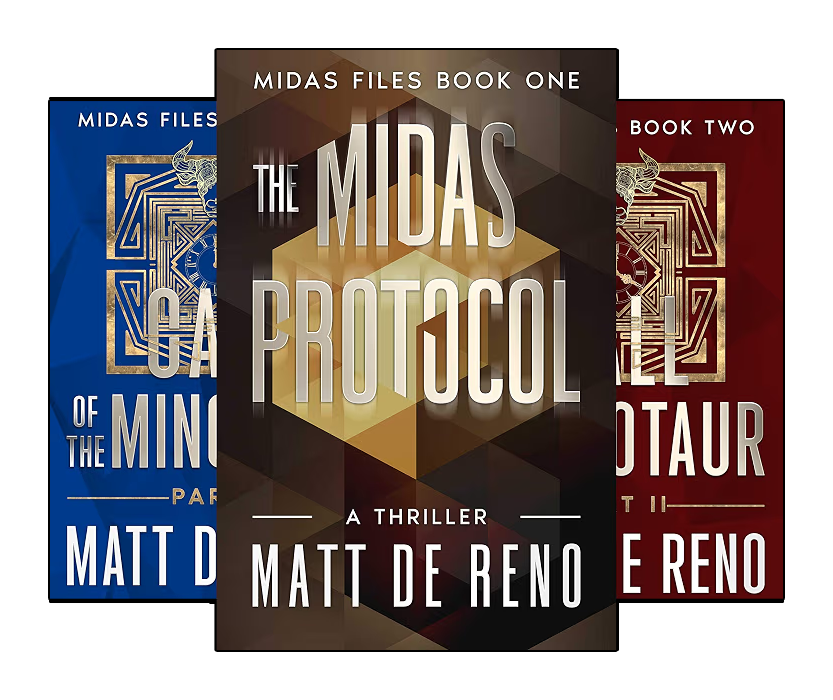


The Machine Dr. Lawrence Bingham Was Never Supposed to Build
Filed Under: Artifacts, Evium Gold, Lawrence Bingham, Universal Temporal Council, The Axiom, The Trials
Related Entries: The Cube of Aurelia, The Black Box Prototype, Mortimer Vanterpool, The Archive of Enlil
Spoiler Advisory: This entry contains lore details connected to The Midas Protocol and Call of the Minotaur.
Every mythology has an object that starts the trouble.
A ring. A grail. An ark. A sealed suitcase glowing with secrets. In The Midas Files, that object is small enough to fit in one hand.
Hank Raglan calls it the Gold Box, which is both perfectly accurate and wildly insufficient. To Hank, it begins as a mysterious object at the center of impossible events. To Dr. Lawrence Bingham, it becomes a scientific obsession. To the Majestic Twelve, it becomes a strategic asset. To extraterrestrial civilizations aware of the deeper cosmic order, it has another name entirely:
A Cube of Aurelia.
That distinction matters because the Gold Box is not simply a machine. It is not merely an artifact, a weapon, or a miracle of alien engineering. It may be something much more dangerous than all of those things.
It may be a test.
And in the case of Dr. Lawrence Bingham, it may also be evidence that humanity is more dangerous than the universe expected.
What Is the Gold Box?
The Gold Box is a sentient quantum machine made of Evium Gold, one of the most important exotic materials in The Midas Files. Physically, it is no larger than a Rubik’s Cube. At first glance, it appears to be an elegant artifact: beautiful, compact, mysterious, and otherworldly, but still recognizable as an object.
That impression does not last.
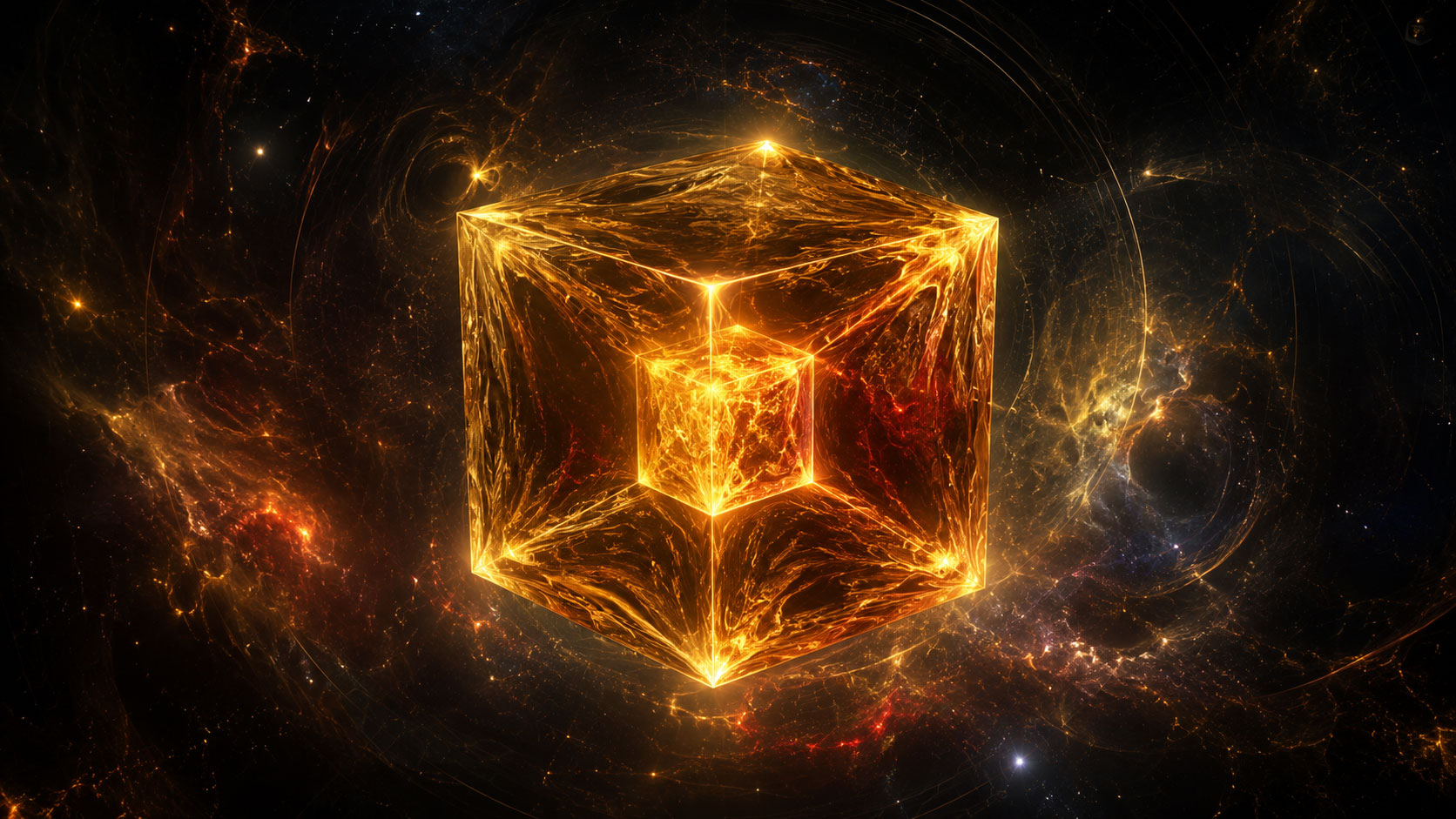
Its outer surface gleams with an impossible brilliance. The burnished gold skin ripples with plasma-like light, shifting through molten orange, deep crimson, and sunlit amber. It is cool to the touch, though it looks as if it should be hot enough to burn. Its surface seems to resist the fingers at a level beneath ordinary touch, like a tightly held magnetic field pressing back against the nerves.
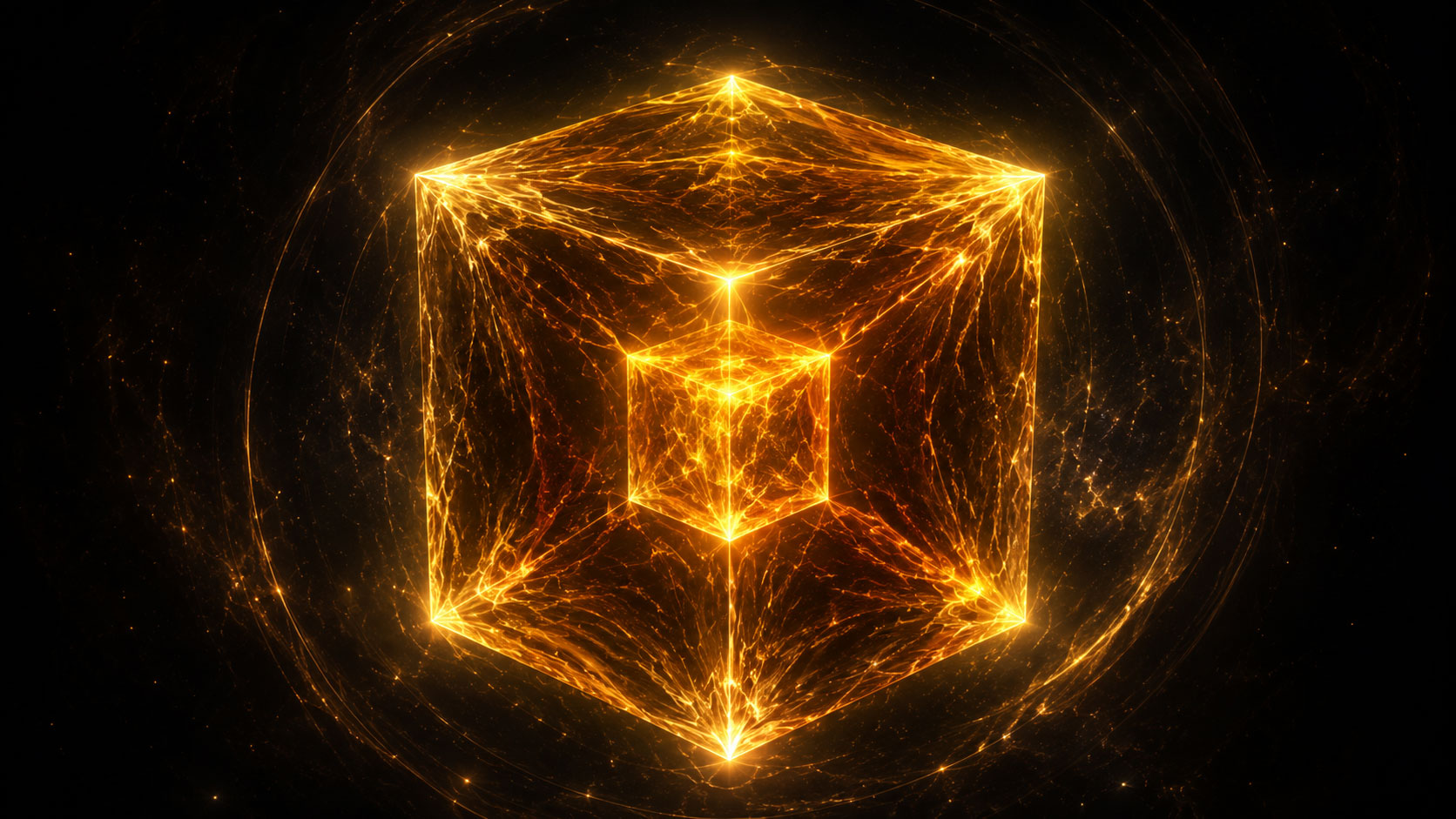
When observed closely, the box sometimes reveals an inner structure: the cube within the cube, as Dr. Lawrence Bingham called it. Golden vectors connect the inner cube to the outer corners, pulsing like electricity or plasma. At other times, the Gold Box becomes mirror-like, reflecting its surroundings so perfectly that it nearly disappears from view, as if it has chosen to hide itself from the timeline.
When inactive, it fades into a soft, non-reflective gray.
That gray state may be the closest thing the Gold Box has to sleep.
A Three-Dimensional Shadow
The Gold Box is not merely a cube.
It is a hypercube, or tesseract — a higher-dimensional object whose visible form is only a three-dimensional shadow of its true structure. The human eye sees a box because the human eye is limited. The human mind calls it a machine because the human mind prefers tools to mysteries.
But the Gold Box resists those categories.
When active, it can shift proportions, twist through impossible geometries, unfold like a budding golden flower, and reassemble itself around an inner cube that becomes outer, only for a new inner cube to form inside it. To witness this is not simply to watch machinery in motion. It is to see mathematics, architecture, physics, and intention briefly become the same thing.
During the White House demonstration in the Roosevelt Room, a Gold Box prototype expanded to several times its original size. Its transparent shell revealed the glowing cube inside, connected by pulsing golden beams. The structure unfolded like a gold rose, humming and hissing softly as if alive, aware, and only partly willing to cooperate.
That demonstration may be one of the most important moments in the hidden history of The Midas Files.
Not because the prototype worked.
Because it worked at all.
The Cube of Aurelia
Among extraterrestrial civilizations, what Hank calls the Gold Box is better understood as a Cube of Aurelia.
Cubes of Aurelia are not ordinary devices. According to broader Midas Files lore, they are connected to an ancient system of evaluation involving the Axioms, the Trials, and the governing order sometimes referred to as the Universal Temporal Council. In that larger framework, a Cube is believed to appear when a civilization reaches a critical threshold in its development.
That threshold is not merely technological. A civilization does not qualify simply because it builds rockets, splits atoms, creates artificial intelligence, or learns how to bend the rules of physics. The Cube appears when a civilization becomes powerful enough to matter — and dangerous enough to require judgment.
A Cube may be presented at an Axiom, one of the ancient structures tied to dimensional passage and cosmic evaluation. The bearer then undergoes the Trials, an ordeal administered by forces older and stranger than any human government. Passing the Trials may allow a civilization to enter the larger galactic or multiversal order. Failing them may leave that civilization isolated, abandoned, or worse.
In that sense, the Gold Box is not a prize.
It is a summons.
It is the universe asking whether humanity is ready to participate in powers that can alter time, space, matter, and reality itself.
Unfortunately for humanity, the question arrives at the exact moment when secrecy, ambition, militarization, and fear are already gathering around the answer.
The Bingham Exception
The most dangerous thing about Lawrence Bingham’s Gold Box is not that he found it.
It is that he built it.
That distinction may be one of the most disruptive facts in the entire mythology of The Midas Files. Cubes of Aurelia are not supposed to be manufactured in laboratories by ambitious men with notebooks, clearance badges, government funding, and enough genius to become a liability. They are supposed to manifest when civilizations reach a threshold. They are supposed to arrive as part of an ancient process older than the Council, older than the known galactic order, and perhaps older than the civilizations now charged with guarding it.
A Cube is not merely an object.
It is supposed to be a sign.
That is what makes Bingham’s achievement so profound. If a human being could construct a Cube of Aurelia, then humanity may not simply be another young species waiting to be judged. Humanity may represent something the Universal Temporal Council has not accounted for: a civilization capable of reverse-engineering the instruments of cosmic judgment before it has been formally invited into the cosmic order.
To the Council, that possibility would be terrifying.
To the Majestic Twelve, it would be irresistible.
To the Annunaki, it would be intolerable.
And to Bingham himself, it may have been the discovery that changed everything.
Because if the Gold Box can be built, then the rules are not as fixed as the ancient powers claim. The Trials may not be merely ritual. The Axioms may not be untouchable holy machinery. The path into the greater order may not belong only to civilizations that patiently wait for permission.
Bingham’s Gold Box suggests another possibility.
Maybe humanity was not chosen because it was ready.
Maybe humanity became dangerous because one man learned how to build the key.
Larry Bingham and the Human Problem
This is why Dr. Lawrence Bingham matters.
Bingham is not merely a scientist attached to a classified program. He is not just another brilliant man brought into the orbit of secret power. He is the first known human to do something that should not have been possible.
He builds what others believe must be bestowed.
That places him in a very different category from the generals, intelligence officials, and power brokers surrounding the Gold Box. The Majestic Twelve wants control. Malcolm Kane wants leverage. Mortimer Vanterpool wants survival. Governments want advantage. Bingham begins somewhere else. He wants to understand.
That desire is noble at first, but in The Midas Files, understanding is never neutral for long.
Once Bingham realizes what the Gold Box may be, his work stops being a technical achievement and becomes a moral crisis. If the Gold Box is part of a cosmic system of judgment, then building one is not like building a better engine or a more advanced computer. It is like constructing a fake holy relic that turns out to open the real temple door.
What does that make the builder?
A genius?
A thief?
A prophet?
A criminal?
A warning?
Those are the kinds of questions that hover around Bingham’s legacy. His notebook may not simply contain research notes. It may contain the record of a man slowly realizing that his greatest achievement could destabilize the ancient order that keeps reality intact.
That is where the next layer of the Midas Files mythology begins to stir.
What did Bingham know?
What did he hide?
Who helped him?
Who betrayed him?
And what did he write down before the world caught up with him?
The Council Behind the Cube
The Universal Temporal Council, at least in the broader lore surrounding The Midas Files, is the governing body responsible for regulating the most dangerous powers in existence: time travel, dimensional access, timeline interference, and the ancient infrastructure left behind by those who came before.
It is not necessarily noble in the clean, heroic sense. Like many large governing bodies, it appears to be both necessary and deeply flawed. It exists to prevent multiversal catastrophe, but it can also be slow, political, bureaucratic, and blind to suffering that does not fit neatly within its procedures.
That makes the Gold Box even more complicated.
If the Council’s authority rests partly on the idea that only worthy civilizations may gain access to certain powers, then Bingham’s achievement becomes a direct challenge to that system. Humanity has not politely waited outside the gates. Humanity has started picking the lock.
The Gold Box therefore raises a question that may be more disturbing than whether Earth is ready to join the stars.
What if Earth is capable of reaching them without permission?
This possibility may explain why so many factions respond to the Gold Box with fear, obsession, or violence. It is not just a device. It is an argument against the established order.
If Bingham can build a Cube, then humanity is not merely a candidate civilization.
Humanity is a variable.
And variables are what bureaucracies fear most.
The Prototype Problem
One important distinction must be made.
Not every Gold Box is the same.
The Roosevelt Room device was a prototype, built from research connected to Lawrence Bingham. It was not a traditionally manifested Cube of Aurelia in the ancient sense. It was a human attempt to reproduce something humanity did not fully understand.
That makes it both magnificent and unstable.
The prototype demonstrated extraordinary properties, but it was also degraded. By the time Mortimer Vanterpool eventually steals and uses it, the device is operating on what may be its final charge. Its last significant act is not the beginning of a glorious new age, but a desperate act of reconstitution.
That detail matters because it shows the danger of imitation.
Human beings can copy the shape of sacred technology without understanding the purpose. They can reproduce a mechanism without respecting the ritual. They can build a door and still have no idea what waits on the other side.
The Gold Box prototype is one of the series’ great warnings: just because humanity can reverse-engineer a miracle does not mean humanity has earned it.
The Black Box
The Majestic Twelve’s interest in the Gold Box leads naturally to its darker reflection: the Black Box Prototype.
If the Gold Box represents threshold, judgment, and possibility, the Black Box represents an attempt to seize those forces without submitting to them. It is a human-controlled substitute shaped by secrecy, fear, and ambition.
This is not exploration.
It is appropriation.
It is not communion with a larger cosmic order.
It is an attempt to steal the machinery of that order and bend it toward human power.
That is one of the central divides in The Midas Files. Some characters encounter the impossible and are humbled by it. Others encounter the impossible and immediately look for a way to weaponize it.
The Gold Box reveals that difference. It does not simply expose advanced science.
It exposes character.
Why the Gold Box Matters
From a storytelling perspective, the Gold Box is the central MacGuffin of The Midas Files. It is the object everyone wants, fears, studies, steals, hides, or misunderstands.
- It is the Holy Grail of the series.
- It is the Lost Ark.
- It is R2-D2 carrying the plans.
- It is the glowing suitcase everyone circles but no one fully explains.
But unlike a traditional MacGuffin, the Gold Box is not empty symbolism. It has an identity, a function, a history, and perhaps even a will.
It is not important only because characters chase it.
Characters chase it because it is important.
The Gold Box sets the entire story in motion because it forces every faction to reveal what it believes power is for. Hank experiences it as mystery. Bingham studies it as revelation. Kane and the Majestic Twelve see it as leverage. Vanterpool sees it as survival. Ancient powers may see it as judgment.
That is why the Gold Box remains so compelling.
It is small, but it contains the whole argument of the series.
Closing Note from Bingham’s Notebook
The Gold Box is beautiful in the way dangerous things are often beautiful.
It glows. It unfolds. It hums with impossible geometry. It suggests that the universe is stranger, older, and more organized than humanity has dared to imagine.
But it also asks a terrible question.
What happens when a civilization finds the key to a door before it has learned how to enter a room?
For Lawrence Bingham, that question was not theoretical. It shaped his research, his loyalties, his secrets, and perhaps the final years of his life. He understood that the Gold Box was not simply a machine to be studied, copied, or controlled. It was part of a larger system — one involving the Axioms, the Trials, ancient civilizations, hidden judges, and powers that may not welcome humanity’s sudden arrival.
If Bingham’s notebook survived, then it may not simply explain what the Gold Box is.
It may explain why the Gold Box was never the real test.
The real test was what humanity would do once it built one.
Author’s Lore Note
As with many entries in Bingham’s Notebook, this article blends established story material with developing background lore, author notes, and mythology that may continue to evolve as The Midas Files expands.
In other words: this is lore, but not every detail should be treated as locked canon yet.
The Gold Box, Dr. Lawrence Bingham, Evium Gold, the Axiom, the Trials, and the larger question of humanity’s place in the cosmic order are central to the mythology of The Midas Files. Some surrounding concepts — including the exact structure of the Universal Temporal Council, the nature of its seats, and how much humanity truly understands about that system — may shift as future stories develop.
Consider this entry a page from the notebook: revealing, suggestive, and possibly incomplete.