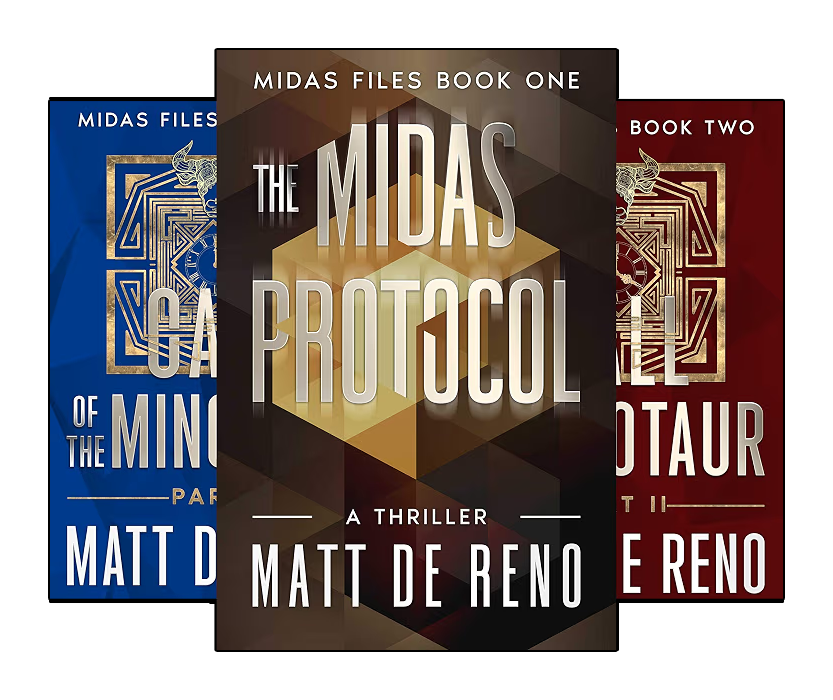

Before Lawrence Bingham built the Gold Box, another Bingham had already stood beside a tesseract.
Spoiler Advisory: This entry discusses lore connected to The Midas Protocol and later implications developed in Call of the Minotaur.
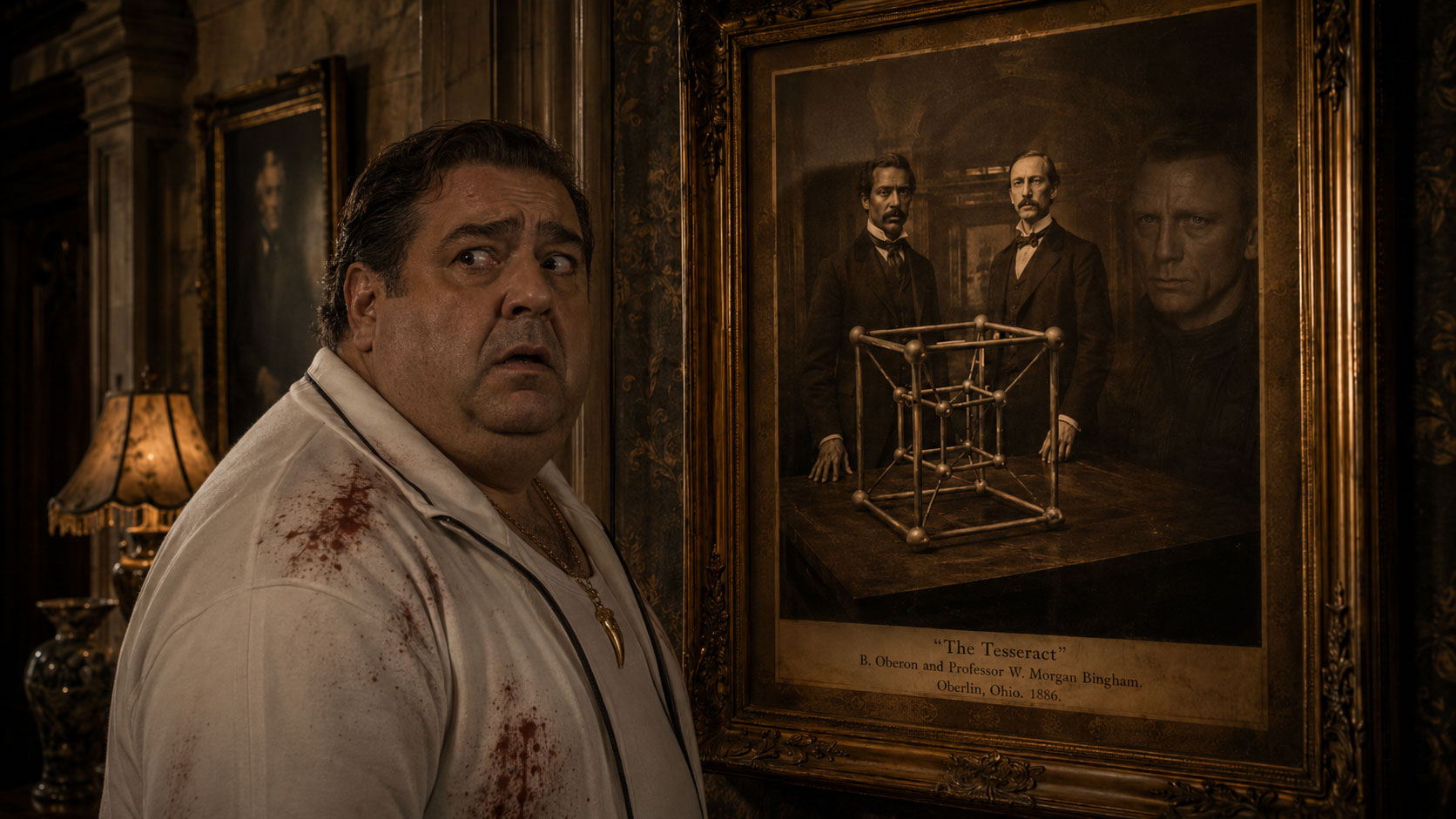
That is the unsettling implication behind one of the strangest images in The Midas Protocol: an antique photograph hanging inside Bingham’s Estate. In the picture, two men stand behind a table displaying a strange cube-within-a-cube model made of odd metal connectors. The caption beneath the photograph reads:
The Tesseract
B. Oberon and Professor W. Morgan Bingham
Oberlin, Ohio. 1886.For Johnny Rocco, the photograph is just one more creepy thing on the wall of a house he does not understand. He is not a scientist. He is not a historian. He is not a man prepared to contemplate higher-dimensional geometry, family legacies, or the possibility that impossible science had been stalking the Bingham bloodline for nearly a century. Then he notices something worse. Not in the photograph. In the reflection.
Mortimer Vanterpool has appeared silently behind him, his cold stare reflected in the glass.
That moment is easy to read as pure menace, and it certainly is. But like many details in The Midas Files, the photograph may be doing more than decorating a scene. It may be quietly telling readers that Lawrence Bingham’s story did not begin with Lawrence Bingham at all.
What Is the Tesseract Photograph?
The Tesseract Photograph is an antique image displayed inside Bingham’s Estate during the 1983 murder sequence in The Midas Protocol. It shows two men standing behind a table with a strange geometric model. The object resembles a cube with a smaller cube inside it, connected at the corners — a classic visual representation of a tesseract, or four-dimensional hypercube.
The caption identifies the two men as B. Oberon and Professor W. Morgan Bingham, and places the photograph in Oberlin, Ohio, in 1886.
Those details matter.
The year matters because 1886 is far too early for this image to feel casual inside the mythology of The Midas Files. The names matter because one of them belongs to the Bingham family and the other belongs to B’yob Oberon, a figure whose presence suggests that the photograph may not simply show academic curiosity.
It may show contact.
Or collaboration.
Or warning.
At the very least, the image implies that ideas central to Lawrence Bingham’s later work — higher-dimensional geometry, cube-within-cube structures, and impossible spatial architecture — had already appeared in his family history long before modern classified research programs entered the picture.
In other words, the photograph raises a dangerous question:
Did Lawrence Bingham discover the impossible?
Or did he inherit it?
The Object in the Photograph
The model in the photograph is described as a strange cube made of unusual metal connectors. A smaller cube sits inside the larger one, joined to it at the corners.
To most people, it might appear to be an obscure scientific model or mathematical curiosity. To readers of The Midas Files, it should feel immediately familiar.
The Gold Box, later studied and built by Dr. Lawrence J. Bingham, is itself tied to higher-dimensional geometry. It is not merely a cube. It is a hypercube — a three-dimensional shadow of a higher-order structure. When active, it reveals an inner cube, connected to its outer geometry by pulsing vectors of light. It folds, unfolds, expands, mirrors, and behaves less like an object than a dimensional argument.
The antique tesseract model is not the Gold Box.
But it may be an ancestor of the idea.
The question is whether the photograph shows a simple mathematical model — or a crude attempt to represent something seen, remembered, or transmitted from elsewhere.
That distinction is crucial. A model can be theoretical. A representation can be devotional. A prototype can be dangerous.
The photograph does not answer which one this is.
That is what makes it so interesting.
Professor W. Morgan Bingham
Professor W. Morgan Bingham is not simply a name in a caption. He is a signal flare fired backward through the mythology. His presence suggests that Lawrence Bingham may come from a family line already connected to forbidden inquiry. W. Morgan Bingham stands beside the tesseract model as if it is important enough to preserve in a formal photograph. This is not a snapshot. It feels staged, commemorative, and intentional.
That raises several possibilities.
Perhaps W. Morgan Bingham was a mathematician or professor exploring higher-dimensional geometry during a time when such ideas were still strange, theoretical, and far from mainstream public understanding.
Perhaps he was part of an early circle of thinkers, inventors, spiritualists, scientists, or fringe scholars experimenting at the edge of what could be explained.
Or perhaps he had encountered something that later generations would call impossible technology.
The photograph does not tell us.
But it does place the Bingham family near the idea of the tesseract decades before Lawrence Bingham’s Gold Box research comes to define the family’s hidden legacy.
That may be coincidence.
In The Midas Files, coincidence is rarely safe.
B’yob Oberon
Then there is the other man in the photograph: B. Oberon.
In the caption, he is presented simply, almost modestly. But within the broader Midas mythology, that name carries weight. B’yob Oberon is one of those figures who feels as if he belongs to the hidden scaffolding behind the visible story — a person or presence standing at the intersection of science, myth, and secret history.
His appearance beside W. Morgan Bingham suggests that the Bingham family’s relationship with impossible knowledge may not have developed in isolation.
Oberon may have been a collaborator.
A teacher.
A benefactor.
A witness.
Or something stranger.
The photograph is especially powerful because it does not explain him. It simply places him there, beside the tesseract, in 1886, long before the events that later consume Lawrence Bingham, Hank Raglan, Malcolm Kane, Mortimer Vanterpool, and the Gold Box.
That is the fun of this kind of lore clue. It feels small on first reading, but it widens the world.
A single caption opens a century.
Johnny Rocco and the Wrong Room
One reason the Tesseract Photograph works so well as a scene detail is that Johnny Rocco is exactly the wrong person to interpret it. He is not standing there as a scholar. He is not making careful observations about nineteenth-century mathematical symbolism. He is a sloppy, frightened mobster in over his head, surrounded by evidence of a world he barely understands. That makes him useful.
Because Rocco sees the photograph the way most people would see it under pressure: as an odd, creepy, old picture on the wall. He notices the strange cube model. He reads the caption. He tries to make sense of it only briefly before fear redirects his attention.
And then Vanterpool appears.
The photograph becomes a mirror. The past and present occupy the same pane of glass. Behind the image of W. Morgan Bingham and B’yob Oberon, Johnny sees the reflection of Mortimer Vanterpool, silent and predatory.
It is a beautifully sinister composition. The tesseract sits inside the photograph. Vanterpool appears inside the reflection. Johnny is trapped between them.
The past is not past. The monster is already in the room. And the house has been telling the truth all along.
Vanterpool in the Glass
Mortimer Vanterpool’s reflection in the photograph is one of those visual moments that summarizes an entire mythology without needing to explain it. Vanterpool is not simply startling Johnny. He is interrupting his encounter with the past. He appears as a living consequence of secrets that began long before either of them entered the room.
That matters because Vanterpool, perhaps more than any other character in this scene, represents the weaponization of hidden history. He is a man shaped by ancient manipulation, modern conspiracy, and personal horror. He is both victim and monster, both controlled instrument and terrifying operator.
Seeing him reflected over the Tesseract Photograph creates a symbolic collision.
The old mystery: W. Morgan Bingham and B’yob Oberon. The modern horror: Mortimer Vanterpool. The connecting thread: impossible geometry, secret inheritance, and the things powerful people do when they learn reality has doors. This is why the image is more than a prop. It turns the wall of Bingham’s Estate into a timeline.
The Photograph and the Gold Box
The Tesseract Photograph also matters because of what it suggests about the Gold Box.
By the time readers encounter Lawrence Bingham’s work, the Gold Box feels like the central impossibility of the series. It is the machine, the artifact, the MacGuffin, the object everyone wants or fears. It is tied to Evium Gold, higher-dimensional physics, the Axiom, and larger questions about humanity’s place in the universe.
But the photograph hints that the conceptual seed of the Gold Box may be much older.
If W. Morgan Bingham stood beside a tesseract model in 1886, then Lawrence Bingham’s later achievement may not have emerged from nowhere. It may have been the culmination of a family obsession, a hidden inheritance, or a trail of knowledge passed down through documents, stories, private collections, or secrets disguised as curiosities.
This does not reduce Lawrence Bingham’s achievement. If anything, it deepens it. He may still be the first known human to build something like a Gold Box. But perhaps he was not the first Bingham to glimpse the shape of the problem.
The Obsidian Veil Connection
In The Midas Protocol, the black triangle associated with the attack on Bingham’s Estate is described from the ground-level perspective of those who witness it. To someone like Johnny Rocco, it is simply a black triangle UFO — an impossible shape in the sky, nameless and terrifying.
That is exactly how such a thing should appear to him. But Call of the Minotaur later gives that craft a name: The Obsidian Veil. The Obsidian Veil is not merely a UFO sighting. It is a specific vehicle in Vanterpool’s arsenal, a silent and predatory craft that later carries him and Grimsby across the globe like a shadow passing over the map.
That later revelation changes how we look back at the murder-night imagery.
The black triangle is not random phenomenon. It is not generic alien weirdness. It is part of Vanterpool’s machinery of power. It belongs to the same hidden world as the tesseract photograph, the Gold Box, the Bingham family secrets, and the violent erasure of those who know too much.
In that sense, the Tesseract Photograph is not only connected to the past. It is surrounded by the future.
Vanterpool in the glass. The Obsidian Veil in the sky. The Gold Box waiting in the mythology. And a dead scientist whose family may have been circling the impossible for generations.
Why This Photograph Matters
The Tesseract Photograph matters because it is a small detail that expands the whole story. It tells readers that the Bingham mystery is older than Lawrence Bingham. It suggests that the Gold Box may not be a sudden invention, but the latest expression of a much older pattern. It connects nineteenth-century mathematical curiosity to twentieth-century classified horror. It places B’yob Oberon beside the Bingham family line. It turns a framed photo into a piece of evidence.
Most importantly, it gives Bingham’s Estate a memory.
The house is not merely filled with expensive furniture and old walls. It contains clues. It contains lineage. It contains artifacts of thought. It contains reminders that the people who lived there were not merely wealthy or eccentric.
They were close to something. Maybe too close. That is what makes the photograph such a strong Bingham’s Notebook entry. It is not the loudest object in the series. It does not glow like the Gold Box, fly like the Obsidian Veil, or kill like Vanterpool. It hangs on a wall. It waits for someone to notice it. Then it reflects the monster standing behind them.
Story Function
From a storytelling standpoint, the Tesseract Photograph does several things at once. First, it creates atmosphere. An old photograph in a strange estate immediately suggests history, class, secrecy, and unease. Second, it rewards close reading. The caption is specific enough to feel important but mysterious enough to remain unresolved. Third, it builds the Bingham family mythology. W. Morgan Bingham’s presence gives Lawrence Bingham a deeper ancestral context. Fourth, it creates a visual bridge between the old and new mysteries. The tesseract model points backward to 1886 and forward to the Gold Box.
Fifth, it gives Vanterpool one of his most chilling entrances. His reflection in the glass turns the photograph into both clue and threat. That is a lot of work for one image on a wall. But that is how lore often works best. Not as an encyclopedia dropped into the story, but as an object a character notices at the worst possible moment.
Symbolic Significance
The Tesseract Photograph represents inherited mystery.
It suggests that the Bingham family may have been living with impossible questions long before Lawrence Bingham entered classified research. It also suggests that certain ideas are not safely contained by time. They pass from person to person, room to room, generation to generation.
A tesseract is already a symbol of higher dimensions — a shape that cannot fully exist in ordinary perception. That makes it perfect for The Midas Files, a series built around the idea that human beings keep mistaking shadows for the whole truth.
The photograph is itself a kind of tesseract. It contains multiple dimensions of story at once:
- A nineteenth-century experiment.
- A family legacy.
- A hidden contact.
- A future invention.
- A murder scene.
- A reflection.
- A warning.
Johnny Rocco sees a picture.
Readers eventually see a doorway.
Closing Note from Bingham’s Notebook
The Tesseract Photograph is one of my favorite kinds of lore object: quiet, specific, and loaded with implication.
It does not explain itself. It does not stop the story for a lecture. It simply appears on the wall of Bingham’s Estate and allows the reader to wonder why it is there:
- Who was Professor W. Morgan Bingham?
- What did B’yob Oberon know?
- Why was the tesseract model important enough to photograph in 1886?
- Did Lawrence Bingham know the history behind the image?
- And did the path to the Gold Box begin long before anyone in the twentieth century believed they were making a new discovery?
That is the kind of question Bingham’s Notebook exists to preserve. Because in The Midas Files, the most dangerous secrets are not always locked in vaults, buried under moon dust, or hidden inside alien machines.
Sometimes they are framed on the wall. Waiting for the glass to catch the light.
Author’s Lore Note
As with many entries in Bingham’s Notebook, this article blends established story material with developing background lore, author notes, and mythology that may continue to evolve as The Midas Files expands.
The Tesseract Photograph, B’yob Oberon, Professor W. Morgan Bingham, Bingham’s Estate, and Vanterpool’s appearance in the reflection are rooted in the mythology of The Midas Protocol. Some surrounding implications — including the full extent of the Bingham family’s connection to higher-dimensional geometry, Oberon’s role, and how this history may connect to Lawrence Bingham’s later work — may continue to develop in future stories.
Consider this entry a page from the notebook: revealing, suggestive, and possibly incomplete.
Filed Under: Artifacts, Images, Bingham Family, B’yob Oberon, The Gold Box, Bingham’s Estate
Related Entries: Dr. Lawrence J. Bingham, Bingham’s Estate, The Gold Box, The Obsidian Veil, Mortimer Vanterpool
First Appearance:The Midas Protocol
Spoiler Advisory: This entry contains lore details connected to The Midas Protocol and background mythology relevant to Call of the Minotaur.