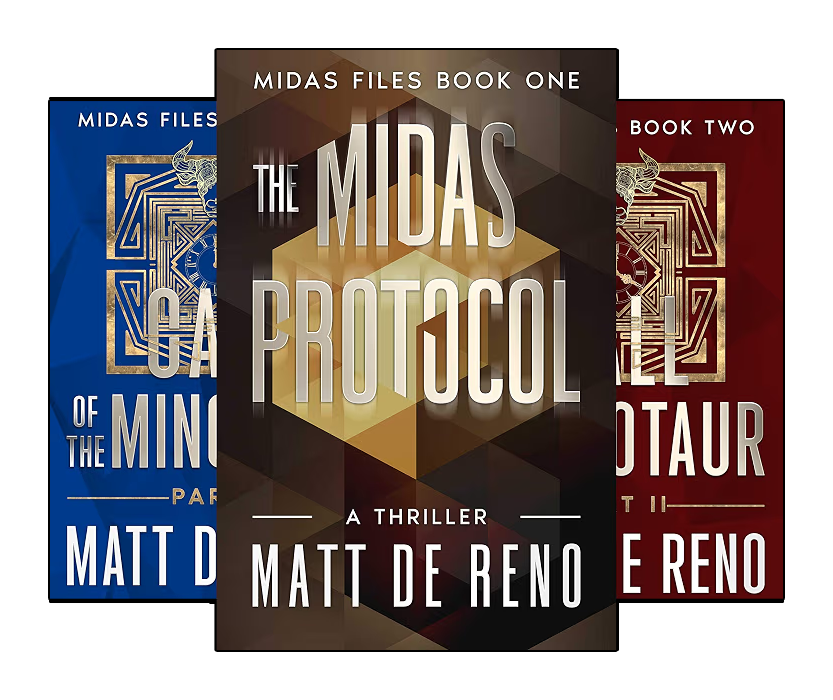

In The Midas Protocol: Midas Files Book One, I introduced time travel with a certain amount of deliberate fuzziness.
That worked for the first book. The mystery of the Gold Box, the hidden history surrounding Dr. Lawrence Bingham, and the larger mythology of The Midas Files were all still emerging. Time travel existed, but the rules did not need to be fully explained yet.
With Call of the Minotaur: Midas Files Book Two, that changes.
The second book moves deeper into time, alternate realities, and the consequences of trying to cross boundaries that probably should not be crossed. That means the series needs clearer mechanics. Not textbook physics. Not a dry rulebook. But enough structure that the reader can feel the logic underneath the mystery.
So how does time travel work in The Midas Files?
The best way I currently understand it is through what I think of as the Foggy Room Theory of Time Travel.
The Foggy Room Theory
Imagine time as a vast foggy room.
Inside that room, visibility is limited. You can move, but you cannot see everything clearly. There is no obvious wall labeled “past” and no clean doorway marked “future.” Instead, all moments exist as locations within the fog, each one related to the others but difficult to perceive from a single point of view.
Human beings experience time from one fixed coordinate: the present.
From that point, we remember what we call the past and move toward what we call the future. But in the larger structure of the universe, past and future may not be as separate as they seem. They are more like positions in the room — accessible in theory, but obscured by fog, distance, and force.
That force is important.
Humans are naturally caught in a future-forward current. We experience time moving in one direction because we are carried by that current, much like a person swept along by a powerful river. We do not feel the room around us. We feel the flow.
Traveling to the Past
In this model, traveling backward in time is possible, but it is extremely difficult.
Moving toward the future is natural because that is the direction of the current. Moving backward means fighting against it. A human being trying to travel into the past is like a swimmer trying to push upstream through a raging river.
The farther back one goes, the stronger the resistance becomes.
This is why time travel cannot be casual in The Midas Files. It cannot be a magic elevator where someone simply presses a year and steps out into history. Travel through time requires power, precision, and a deeper understanding of the forces shaping the temporal current.
That also means mistakes matter.
A person may arrive somewhere they did not intend. They may create effects they do not understand. They may brush against moments that are not meant to be disturbed. In a universe where time has structure, time also has danger.
Civilizations Outside the Current
The next major idea is that not all civilizations experience time the way humans do.
Some advanced civilizations exist outside the normal future-forward current, or at least understand how to step beyond it. These civilizations have developed technologies, disciplines, and rules for navigating the temporal landscape. They can observe moments differently. They can move through time with greater intention. They can see the foggy room more clearly than humans can.
That does not make them gods.
It makes them dangerous.
A civilization capable of moving through time can alter histories, steal futures, erase threats before they emerge, or preserve events that should have collapsed. Time travel becomes more than exploration. It becomes power.
And like all power in The Midas Files, it attracts those who believe they have the right to control it.
The Universal Temporal Council
To prevent chaos, the larger universe needs regulation.
In The Midas Files, that role belongs to the Universal Temporal Council, an ancient governing body charged with protecting the integrity of time. The Council does not merely decide who may travel through time. It exists to prevent civilizations from using time as a weapon against one another.
The Council’s concern is not sentimental. It is existential.
One reckless act in the past could reshape a civilization. One targeted intervention could erase a species, destroy a world, or alter the balance of power across the cosmos. Temporal manipulation is not just dangerous because it creates paradoxes. It is dangerous because it can become a form of conquest.
That is why the Council maintains laws, boundaries, and systems of orientation for advanced civilizations capable of temporal movement.
The Universal Meridian
One of those systems is the Universal Meridian.
The Universal Meridian is the framework by which advanced civilizations orient themselves in time. If the foggy room is the larger metaphor, then the Meridian is the map, compass, and coordinate system. It allows those with the proper knowledge to understand where they are, where they are going, and how their movement may affect the larger temporal order.
Humans, for the most part, do not understand the Meridian.
That ignorance matters. A person who travels through time without understanding the Meridian is not simply lost. They may become dangerous without meaning to be. They may step into the wrong moment, disturb the wrong event, or create consequences that ripple far beyond their own life.
That tension — between human ambition and cosmic order — is central to the series.
Parallel Universes and the Seven Universes
Time travel is only one piece of the larger mythology.
The Midas Files also plays with the idea of parallel universes: realities where events unfolded differently, histories diverged, and alternate versions of familiar people exist along different paths.
Within the mythology of the series, there are Seven Universes accessible from the Prime Universe. These universes are distinct, but not completely separate. At times, events, memories, or impressions may bleed from one reality into another. That overlap may explain phenomena that feel like shared false memories, strange déjà vu, or what people sometimes call Mandela effects.
Every person may have alternate versions across these universes, but intelligent life does not manifest equally in all of them. Like a quantum wave collapsing into a single observed state, a person’s true conscious existence may be concentrated in one universe, while other versions ripple outward as secondary possibilities.
That idea raises larger questions about identity.
What makes a person truly themselves? Is it memory? Body? Choice? Soul? Some deeper essence that exists across realities?
Those questions are exactly the kind of territory The Midas Files is built to explore.
The Problem of Paradox
Of course, time travel always brings paradox.
What happens if someone meets another version of themselves? What happens if they change the life of an ancestor? What happens if they prevent a tragedy that shaped everything that followed?
These are not small questions. In a story world built around hidden technology, ancient power, and cosmic governance, paradox cannot simply be hand-waved away.
The answer, at least for now, is that time resists contradiction.
The temporal current wants continuity. It pushes toward coherence. Small disturbances may be absorbed. Larger changes may create fractures, branches, or consequences that require intervention by forces like the Universal Temporal Council.
In other words, the past can be changed, but not without cost.
And the universe may have ways of collecting that debt.
What This Means for Call of the Minotaur
In Call of the Minotaur, these ideas become more important because Hank Raglan’s journey is no longer only about survival, the Gold Box, or the people searching for him. It is also about the larger forces that have been moving around him since the beginning.
Time is not just a plot device.
It is part of the architecture of the series.
The Gold Box, the Cube of Aurelia, the Axiom, the Folds, the Council, and the mysteries surrounding Hank’s disappearance all connect to a universe where time is less stable, less linear, and far more dangerous than human beings understand.
That is exciting territory as a writer, but also challenging. Every rule creates new possibilities. Every possibility creates new problems. And every problem has to serve the story rather than bury it under explanation.
Still Finding the Shape of Time
The Foggy Room Theory is my current way of understanding time travel in The Midas Files. Like any living mythology, it may evolve as the series deepens and new ideas emerge.
That is part of the fun.
The multiverse allows for mystery. The Council allows for structure. The Folds allow for movement. The human characters allow for consequences.
Somewhere between all of that is the real story.
For now, I know this much: time in The Midas Files is not a straight line. It is a foggy room, a powerful current, a dangerous frontier, and a cosmic system guarded by beings who understand just how much can go wrong when someone thinks they can master it.
So I’ll catch you on the other side of the clock.