There is something especially cruel about a book that survives a catastrophe but cannot survive being read. You can protect it, catalogue it and put it somewhere safe. The one thing you most want to do might destroy the reason you saved it.
That is the predicament of the carbonized papyrus scrolls from Herculaneum. Buried when Vesuvius erupted in AD 79 and rediscovered in the eighteenth century, they preserve part of an ancient library in a form that makes ordinary reading dangerous. Imagine a shelf of books whose covers you cannot open without breaking the pages. Then imagine discovering that the words may still be there. [1]
The obvious thriller question is what those words contain. The more interesting scientific question comes first: how do you establish what is actually written inside?
On June 25, 2026, the Vesuvius Challenge announced an end-to-end virtual reading of the surviving portion of PHerc. 1667. Earlier physical opening attempts had damaged the roll; the achievement concerns the remaining material, not a pristine book recovered in its entirety. The team identifies the text as an ethical treatise with a likely Stoic context, while its author remains unknown. [2, 3]
This is a developing research story, rather than a discovery made this week. The project’s October awards recognize first-letter recoveries from two additional scrolls, PHerc. 306B and PHerc. 343. Those are smaller advances, but they show the effort continuing beyond a single spectacular demonstration. [4]
The June result is described in a preprint by Giorgio Angelotti and colleagues. Its definition of a complete reading still permits damaged passages that cannot be securely transcribed. Some visible traces remain unresolved, and the transcription distinguishes uncertainty and restoration. The paper is presented on arXiv as a preprint, not as a peer-reviewed journal article. [5]
How to Read a Closed Book
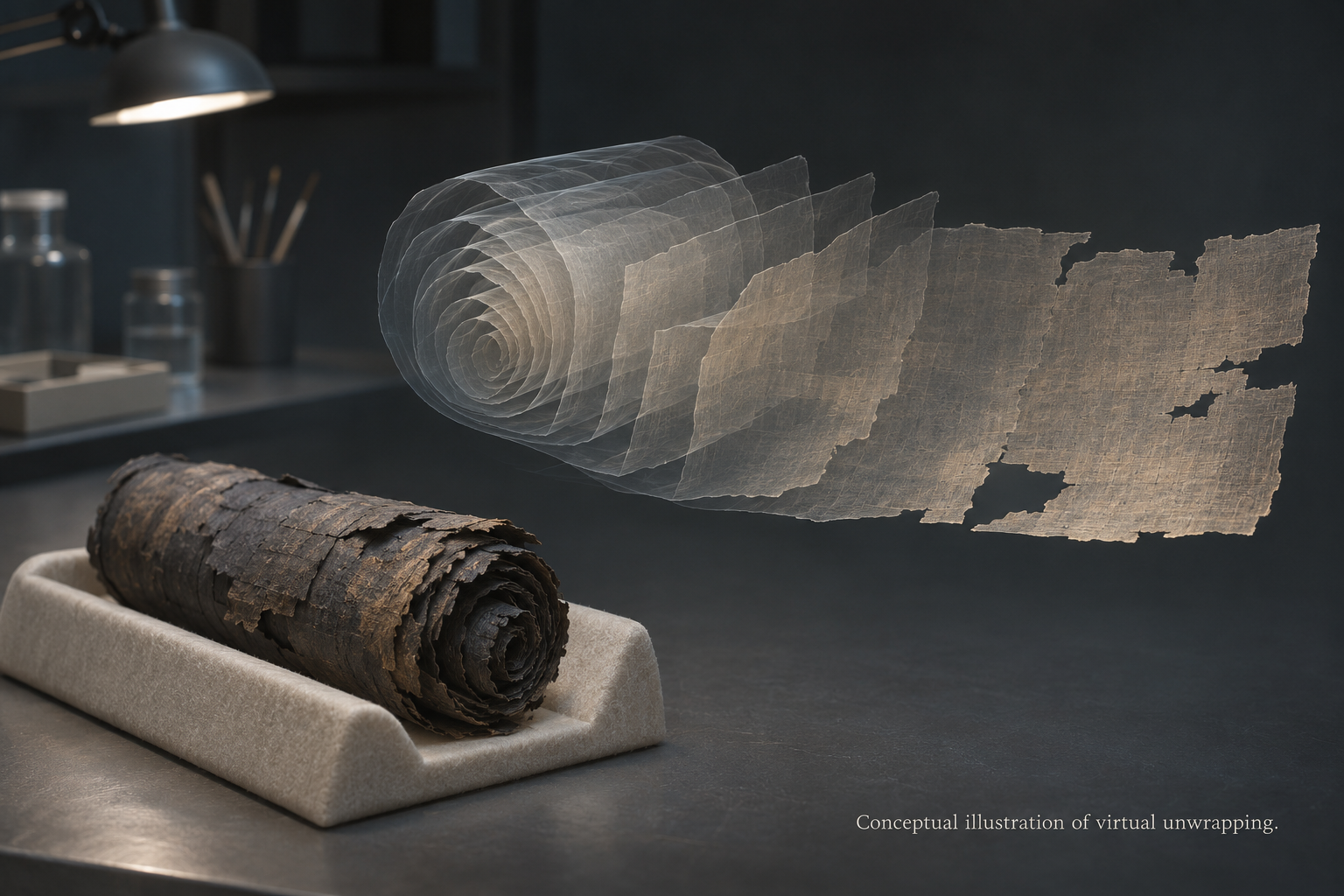
The basic route is wonderfully strange. Researchers collect a three-dimensional X-ray scan, trace the tightly wound writing surface, flatten its digital representation and enhance the ink signal. The physical roll stays rolled. The process is closer to recovering the geometry of a crushed document than taking a photograph through its cover. [2]
Ink creates a further problem. Carbon-based writing on carbonized papyrus offers little straightforward contrast. A separate, peer-reviewed study in Scientific Reports tested whether microscopic surface shape could help distinguish inked areas on already opened fragments. It found a useful signal, but the small dataset and differences between papyri limit the conclusion. The authors describe this as a proof of concept, not a ready-made solution for every sealed scroll. [6]
For the broader virtual-reading work, the June preprint describes ink-enhancement models that are not trained on words or character identities. Human specialists interpret the resulting traces. In one separate scroll, higher-quality scans also allowed the researchers to compare their recovered signal with ink deposits visible directly in the three-dimensional data. That is a physical cross-check, not simply a second fluent answer from software. [5]
I find that division of labor reassuring. A plausible sentence is easy to admire. A faint mark that another researcher can inspect is harder work, and far more useful when the person who wrote it has been dead for two thousand years.
Why It Matters
One of the most striking findings is almost comically modest: a title. In PHerc. 139, researchers identified Philodemus’s On Gods, Book 8. ESRF, the European synchrotron involved in the work, explains the significance: the identification extends a work previously known from its first book to at least eight. A few marks change the outline of a body of thought. [3]
Think about finding the eighth volume of a history when you had believed the work stopped at volume one. You would immediately have new questions about its scope, structure and missing parts. You would not yet know the answers. Even the catalogue entry would force you to reconsider what you thought the library contained.
That is a more satisfying kind of mystery than the familiar promise that an ancient object will overturn everything. Recovering an argument about ethics or the gods can matter without revealing a secret machine. It gives historians something specific to test against the accounts and assumptions already in circulation.
Oxford’s current collaboration with the Vesuvius Challenge is concerned with expanding the ability to interpret recovered texts. Its anticipated scholarly benefits include a richer picture of ancient atomism, free will and logic. Those are research prospects, not findings already delivered by every newly visible column. [7]
We often talk about AI as an answer machine. This project offers a more interesting role: an instrument that helps make evidence available for someone else to judge. Oxford described that separation in its February 2025 account of another scroll, PHerc. 172: the machine-learning task was ink detection, while transcription and translation belonged to scholars. [8]
For anyone who works with consequential information, the distinction should sound familiar. A confident interpretation is only as useful as the evidence you can trace back through it. An attractive reconstruction can conceal an error just as effectively as an ugly scan can conceal a letter. The valuable question is whether another person can follow the path from the conclusion to the thing being measured.
My reading of this work is that the most impressive technology is also making room for restraint. Blank spaces and uncertain readings belong in the result. They tell us where the recovered past ends and our desire for a complete story begins.
This is the kind of real-world question that sits comfortably beside The Midas Files: what changes when something long inaccessible becomes readable? Here the connection is thematic. The scrolls are historical artifacts, and their recovery is a scientific and scholarly undertaking. The thriller possibility lies in what people might do with newly available knowledge; it does not require turning the actual research into evidence of a conspiracy.
Final Thought
A sealed book invites us to imagine an answer. A readable fragment asks us to do something less comfortable: look closely, accept the gaps and allow the surviving words to surprise us.
The remarkable thing about Herculaneum is that the next discovery may already be sitting in a collection. It does not need to be invented. It needs a way to be seen, and someone patient enough to read what is there.
About the Author
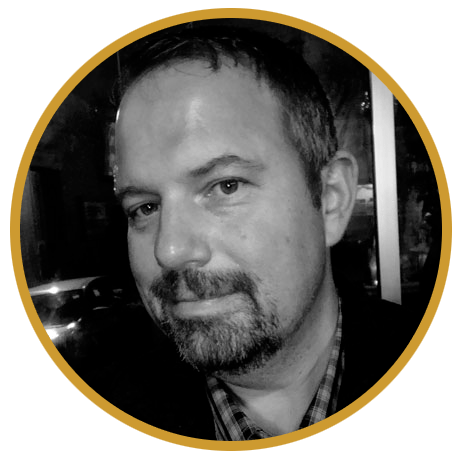 Matt De Reno
 is a writer, editor, content strategist, and technical communicator with more than 20 years of experience helping complex ideas become clear, useful, and engaging. His professional background includes technical documentation, digital publishing, UX-minded content, knowledge management, SEO, and strategic communications for technical audiences. He is also the author of The Midas Files novels, where his fascination with technology, history, fragile systems, and imagination comes together in a sci-fi thriller universe. Connect with Matt on LinkedIn for more on writing, publishing, technology, and the strange places where real ideas start to feel like fiction.