

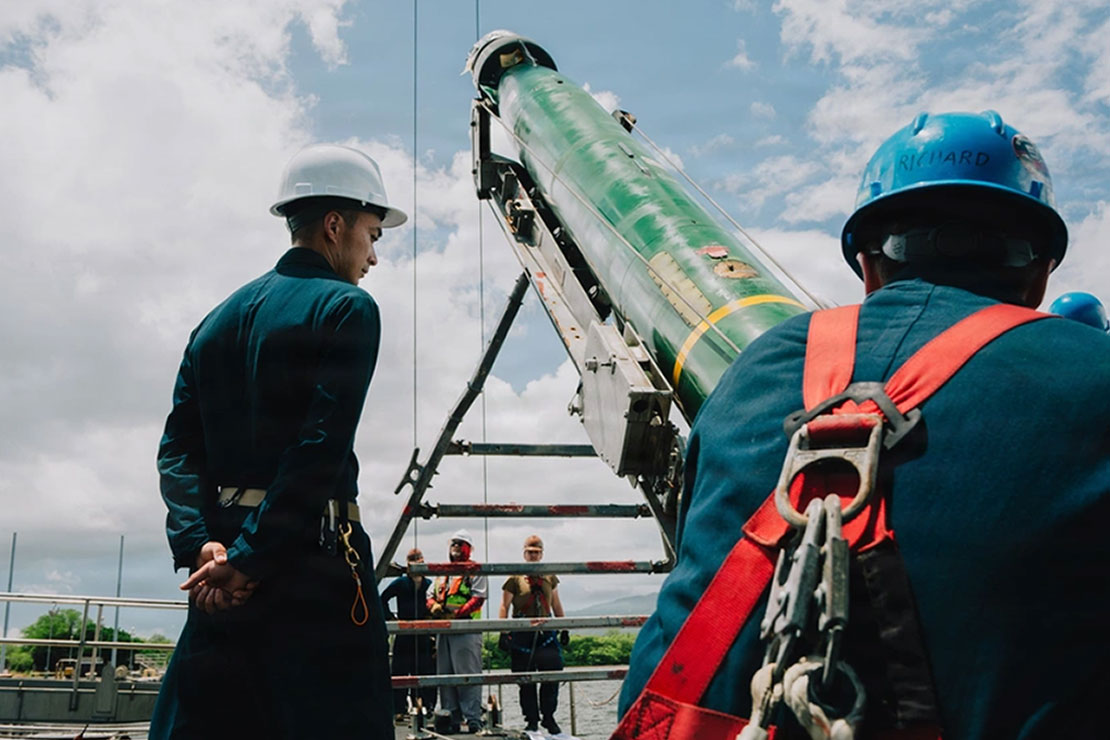
Before the torpedo became a sleek metal predator packed with sonar, guidance software and enough engineering to make a Victorian inventor weep, it was basically an underwater bomb with ambition.
For a long time, the word “torpedo” did not mean what we picture today. Naval torpedoes began as fixed or improvised underwater explosives — what we would now more readily call mines. During the American Revolution, inventor David Bushnell tried to send his one-man submarine Turtle beneath a British warship so its pilot could attach an explosive charge to the hull. The attack failed, but the idea was already there: the safest way to hurt a ship might be to attack the part of it nobody could armor with cannons — the part below the waterline.
Robert Fulton pushed the concept further in the early 1800s. Better known for steamboats, Fulton became obsessed with underwater explosives and tried to sell European governments, and later the United States, on what he openly called “torpedoes.” His devices were closer to anchored mines or explosive charges than modern self-propelled weapons. Navy officers were skeptical. Some considered the whole idea sneaky, ungentlemanly and unreliable. Which, in retrospect, was a fairly accurate description of why it was eventually going to work.
The American Civil War made underwater warfare much less theoretical. Both sides used mines, small attack craft and spar torpedoes — explosive charges mounted on the end of a long pole. The most famous example came on February 17, 1864, when the Confederate submarine H. L. Hunley attacked USS Housatonic outside Charleston Harbor. Hunley carried a black-powder charge on a 16-foot spar and rammed it into the Union ship below the waterline. Housatonic sank within minutes. Hunley also disappeared with her entire crew, but the attack made history as the first time a submarine sank an enemy warship in combat.
That was the brutal early equation of torpedo warfare: get close enough to stick a bomb into the other ship and hope you survive the attempt.
Then the weapon learned to swim.
In 1866, English engineer Robert Whitehead produced the first successful self-propelled “automobile” torpedo. Working from an idea associated with Austrian naval officer Giovanni Luppis, Whitehead solved the problems that mattered most. His torpedo used compressed air for propulsion, could hold a reasonably consistent depth, and eventually incorporated gyroscopic stabilization. Early versions were slow by modern standards — roughly 6.5 knots for about 200 yards — but that almost misses the point. For the first time, the explosive weapon could leave the launching vessel and travel underwater toward a target under its own power.
That changed naval architecture almost immediately. The torpedo did not need to defeat a battleship’s thickest armor belt or trade cannon fire with a larger vessel. A comparatively small boat could carry a weapon capable of punching into the vulnerable underwater hull of a much larger ship. By the late nineteenth century, navies were building torpedo boats, torpedo-boat destroyers and submarines around that basic fact. The torpedo helped create entire classes of warships simply because everybody now had to worry about what might be coming through the water toward them.
The United States initially tried to build its own alternative. Lieutenant Commander John Howell developed a wonderfully strange torpedo powered by a 132-pound flywheel spun to about 10,000 revolutions per minute before launch. The flywheel both stored energy and helped stabilize the weapon gyroscopically. Around fifty Howell torpedoes entered U.S. Navy service, but the Whitehead design and its descendants ultimately won the evolutionary contest.
By World War I, torpedoes were no longer experimental curiosities. They were standard naval weapons. Surface ships carried them. Submarines depended on them. Aircraft would soon be dropping them. The torpedo had become the underwater equivalent of a guided punch, except that early versions were not really guided at all. Once fired, they largely ran the course and depth they had been set to run. Hitting a moving ship required solving a geometry problem involving target course, target speed, range, torpedo speed and the uncomfortable knowledge that the target might turn at any moment.
The interwar years turned that straight-running weapon into something recognizably modern. Engines improved. Warheads grew more powerful. Detonators evolved from simple impact mechanisms toward influence systems designed to explode beneath or near a target. Aircraft-launched torpedoes became practical. Submarines gained better fire-control methods. Torpedoes became faster, longer-ranged and much more complicated.
World War II then demonstrated both the terrifying potential of the technology and the danger of believing your own engineering paperwork.
Japan entered the war with the Type 93 oxygen torpedo, later nicknamed the “Long Lance.” It was faster, longer-ranged and more powerful than Allied officers initially believed possible. The United States, meanwhile, entered the Pacific war with the Mark 14 submarine torpedo — a sophisticated weapon that suffered from a nightmare stack of problems. It ran too deep. Its magnetic exploder could detonate prematurely. Its contact exploder could fail even on a seemingly perfect hit. Some torpedoes could even circle back toward the submarine that fired them. U.S. submariners repeatedly reported the failures, while shore organizations initially resisted the idea that the weapon itself might be at fault.
Eventually the problems were tested, identified and corrected, and the Mark 14 became a devastatingly effective weapon. But the episode remains one of the great engineering cautionary tales: a weapon can be advanced on paper, expensive to build and supported by smart people — and still fail if it is not tested realistically enough.
The other great wartime leap was that torpedoes began to listen.
The Mark 24, nicknamed “Fido,” was an air-dropped acoustic-homing anti-submarine torpedo introduced during World War II. Instead of simply running a preset course, it could home on underwater sound. That is the moment the family tree begins looking less like artillery and more like robotics. The torpedo was no longer merely launched. It could sense something about its environment and alter its behavior in response.
Postwar torpedo development accelerated that trend. Homing systems became more capable. Sonar became central. Wire guidance allowed a submarine to send information to a torpedo after launch while the weapon could also use its own sensors. Digital electronics replaced more mechanical and analog functions. Software became part of the weapon in a way Robert Whitehead could never have imagined.
By the Cold War, the torpedo had evolved into a highly specialized underwater vehicle designed not only to move fast, but to detect, classify, pursue and re-attack targets in a three-dimensional environment where sound bends, water temperature changes, countermeasures interfere and the target is actively trying not to be found. The U.S. Navy’s heavyweight Mark 48 family, for example, incorporated homing sonar and wire guidance, while later digital guidance systems made it possible to improve performance through software changes. Lightweight anti-submarine torpedoes followed a similar path. The modern Mark 54 combines proven torpedo hardware with digital signal processing and software-driven guidance and control.
And that may be the strangest part of the whole history.
The torpedo started as a bomb somebody hid underwater. Then it became a bomb on a pole. Then a mechanical fish. Then a self-propelled machine with gyroscopes. Then a weapon that could hear. Then one that could be steered after launch. Then one whose behavior could be changed by code.
In other words, the history of the torpedo is not just a history of explosives. It is a compressed history of engineering itself: propulsion, control theory, gyroscopes, acoustics, sensors, computation, software and the endless human urge to make a machine do something difficult in an environment that does not cooperate.
That is the part I find most interesting. The explosion is obvious. The real story is the machine learning, generation by generation, how to find its own way through the dark.
About the Author
 Matt De Reno
Matt De Reno is a writer, editor, content strategist, and technical communicator with more than 20 years of experience helping complex ideas become clear, useful, and engaging. His professional background includes technical documentation, digital publishing, UX-minded content, knowledge management, SEO, and strategic communications for technical audiences. He is also the author of The Midas Files novels, where his fascination with technology, history, fragile systems, and imagination comes together in a sci-fi thriller universe. Connect with Matt on LinkedIn for more on writing, publishing, technology, and the strange places where real ideas start to feel like fiction.