
MIAMI — The Funny Newz has learned that Moroni Associates, an IT staffing agency in Miami, has implemented a bold new workplace communication policy limiting employees to ten approved words and phrases.
Company officials say the change is part of a broader effort to streamline internal communication, reduce meeting times, and prevent employees from saying things that reveal how little they understand about their jobs.
Terry Martinovic, a human resources executive at Moroni Associates, created what he calls the company’s “Ten Golden Words” policy after years of listening to what he described as “incessant workplace blather.”
“I was tired of hearing employees talk,” Martinovic said. “Nowadays, the ability to maintain an intelligent conversation appears to be a lost art. So why let people keep proving that every time they open their mouths?”
The Ten Golden Words
According to Martinovic, most rank-and-file employees can complete an entire workday using only the approved list.
“My system takes the guesswork out of thinking,” he said. “At the same time, it allows freedom of expression through cool, trendy workplace terms that sound vaguely professional.”
The approved words and phrases are as follows:
1. Yes
Employees may say “yes” in response to any management request, assignment, accusation, schedule change, or unpaid weekend obligation.
Approved add-ons include “boss,” “captain,” “chief,” and “sir-ee Bob.”
Example:
Boss: “Can you finish the Henderson report by noon, skip lunch, and pretend this was your idea?”
Employee: “Yes, boss.”
2. No
Employees may say “no” only in approved formats.
Approved variations include “no can do,” “no way,” and “no, what part didn’t you understand?”
Martinovic said this phrase is to be used carefully.
“Employees should not say no to management,” he explained. “But they may say no to other employees, vendors, family members, and any caller asking about salary transparency.”
3. Booyah
Employees may use either “Booyah” or “Daaamnnn,” but not both.
The company believes allowing both would create chaos.
Example:
Boss: “Everybody gets a 10% bonus this month.”
Employee: “Booyah!”
Martinovic later clarified that this example was hypothetical and should not be interpreted as a promise, forecast, rumor, or legally actionable statement.
4. That’s About Right
This phrase is used to acknowledge predictable disappointment.
Example:
Employee #1: “Did you hear John called off again on the heaviest work-volume day of the month?”
Employee #2: “That’s about right.”
Martinovic says the phrase has already reduced unnecessary follow-up questions by 43%.
“Employees no longer ask why something stupid happened,” he said. “They simply recognize that it did.”
5. ASAP
Employees may use ASAP when communicating urgency without accepting responsibility.
Example:
Boss: “I need you to get me a bagel, ASAP.”
Employee: “Yes, boss.”
Employees are permitted to scratch their nose during this exchange, provided the gesture remains technically deniable.
6. Noted
“Noted” is used when an employee must acknowledge criticism while privately filing it in the emotional trash.
Example:
Boss: “The work you did on the Henderson account was terrible.”
Employee: “Noted.”
Martinovic considers “noted” one of the most powerful words in the modern workplace.
“It means everything and nothing,” he said. “That is the sweet spot of corporate communication.”
7. Will Do
Employees may use “will do” to accept any assignment, even one they have no intention of completing without at least three follow-up emails and a mild panic attack.
Example:
Boss: “I need you to work all weekend without overtime.”
Employee: “Will do.”
8. Cool Beans
“Cool Beans” is approved for promotions, free lunches, software updates that do not crash immediately, and any meeting canceled less than five minutes before it starts.
Example:
Boss: “You have been promoted.”
Employee: “Cool beans.”
Martinovic said “cool beans” tested well with management because it conveys enthusiasm without requiring a raise.
9. I Aim to Please
This phrase is used when employees want to sound cooperative while having no measurable plan.
Example:
Boss: “Do you think you’ll reach those projected sales figures?”
Employee: “I aim to please.”
According to Martinovic, this phrase has replaced longer, less useful responses such as “I’ll do my best,” “We’ll see,” and “Those numbers were made up by a consultant who has never met our clients.”
10. Beer?
Employees may choose either “Beer?” or “Margaritas?” as an approved after-work morale phrase, but they must select only one.
Example:
Employee #1: “Beer?”
Employee #2: “Booyah.”
Martinovic said this rule is designed to protect workplace culture from beverage-based ambiguity.
“You can ask ‘Beer?’ or you can ask ‘Margaritas?’” he said. “But not both. That kind of indecision is how committees happen.”
Nonverbal Communication Coming Soon
Martinovic said he is also developing a list of approved nonverbal workplace gestures.
Early candidates include finger guns, fist pumps, dramatic thumbs-up motions, and a controlled eye-roll that can be plausibly attributed to allergies.
One proposed gesture, described only as “the universal symbol for being jerked around by management,” remains under review by legal.
“We want employees to express themselves,” Martinovic said. “We just want them to do it in a way that cannot be used against us in arbitration.”
Management Gets Its Own List
Moroni Associates is also considering a separate approved vocabulary for managers.
Draft phrases include:
“Why is this still open?”
“Who owns this?”
“Let’s circle back.”
“This should be easy.”
“Just get it done.”
“Why does this person still work here?”
Martinovic said the management list will be more flexible because leaders need room to innovate, inspire, and blame downstream.
“Executives require nuance,” he said. “Employees require boundaries.”
Corporate Jargon Still Allowed, Unfortunately
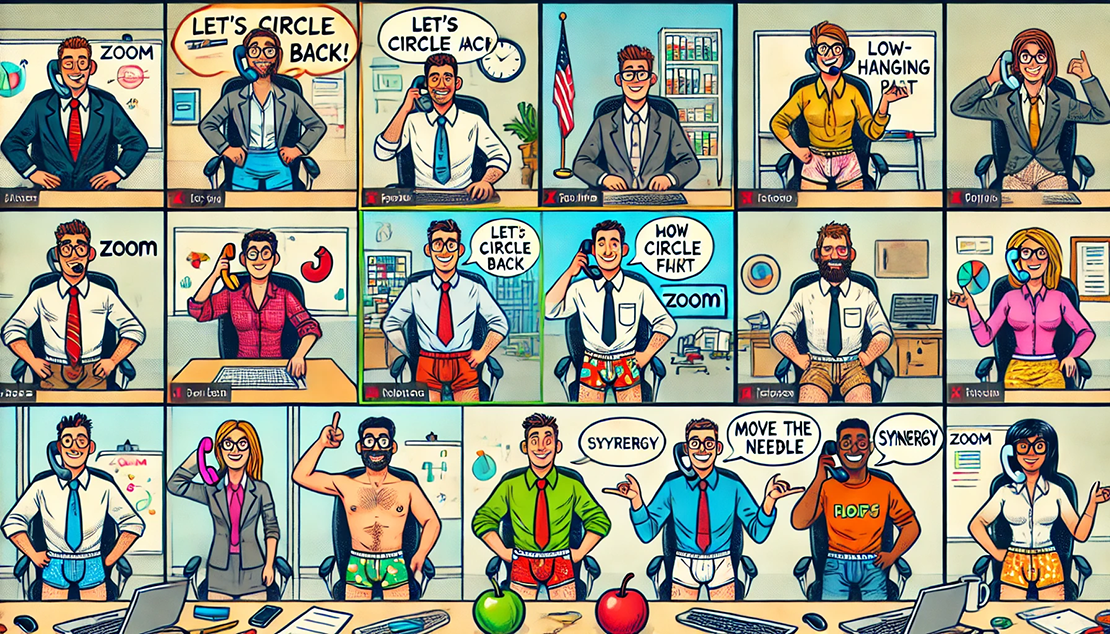
Although the new policy limits ordinary employees to ten approved phrases, Moroni Associates will continue allowing senior leadership to use standard corporate jargon, including “synergy,” “deep dive,” “bandwidth,” “low-hanging fruit,” “move the needle,” “circle back,” “take this offline,” and “run it up the flagpole.”
Martinovic defended the decision.
“Jargon is essential at the leadership level,” he said. “Without it, executives would be forced to say what they actually mean.”
Employees have expressed mixed reactions to the new policy.
When asked for comment, one worker stared blankly for several seconds before saying, “Noted.”
Another gave finger guns.
A third whispered, “Beer?” and was immediately promoted to team lead.
The Future of Workplace Communication
Martinovic believes the Ten Golden Words policy could revolutionize corporate America.
“Most workplace communication is unnecessary,” he said. “The rest can be handled with ‘yes,’ ‘noted,’ and a well-timed ‘cool beans.’”
When The Funny Newz asked whether employees could substitute “wine?” for “beer?” or “margaritas?” Martinovic frowned.
“That is exactly the kind of communication creep we are trying to prevent,” he said.
Then he pointed toward the door and added, “No. What part didn’t you understand?”
Editor’s Note: The Funny Newz is satire. Please do not limit your employees to ten words unless you are prepared for them to use “noted” with devastating emotional precision.