

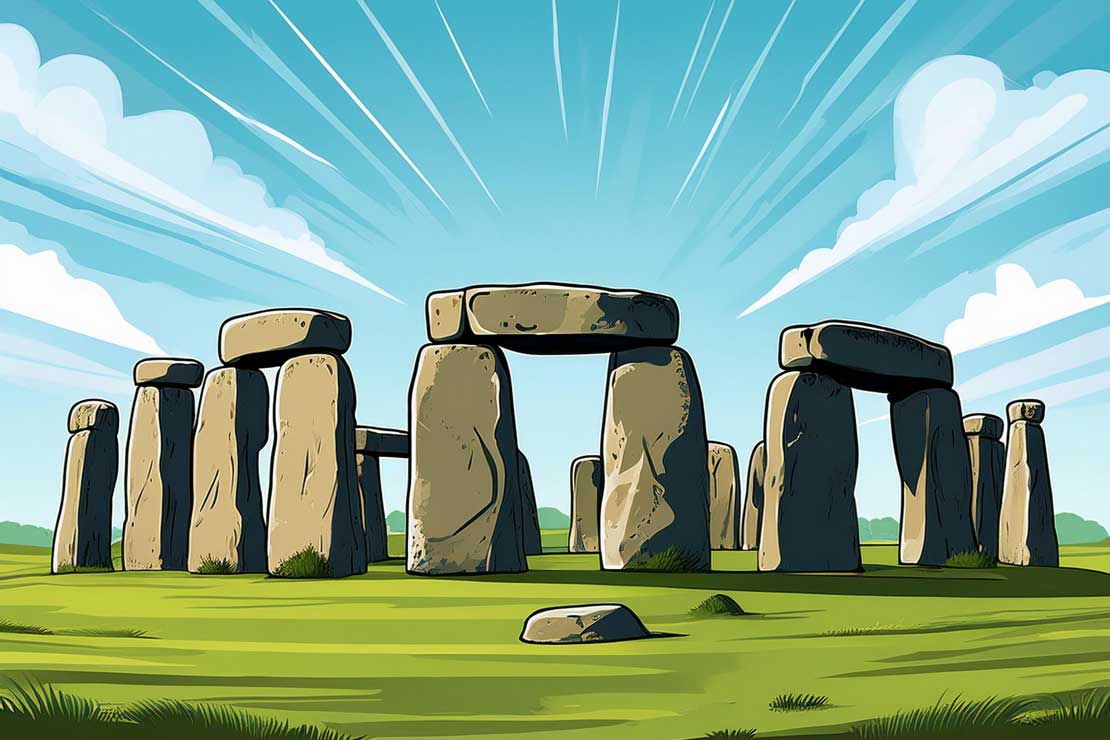
SALISBURY, ENGLAND — World-renowned scientist Dr. Frederick Diffendorfer of the Archaeological Institute for the Preservation of Pedantic Study plans to publish a groundbreaking paper this summer on Stonehenge, shortly after resolving what his legal team continues to call “an unfortunate plagiarism misunderstanding.”
In an exclusive interview with The Funny Newz, Diffendorfer revealed his central finding: Stonehenge, one of humanity’s oldest and most mysterious monuments, was not a sacred temple, burial site, astronomical calendar, or alien landing pad.
It was a public works boondoggle.
According to Diffendorfer, the ancient monument was designed to track the sun, moon, and stars, but ultimately failed due to what he calls a “glaring Y0K problem.”
“It counted backward toward the year zero,” Diffendorfer explained. “The Druids knew it wasn’t savior-compliant, but by then they had already spent the grant money.”
The Ancient Clock That Couldn’t
Much like the Y2K panic that worried modern computer users, Diffendorfer believes Stonehenge suffered from an ancient countdown flaw.
“The system was state-of-the-art for its time,” he said. “Unfortunately, no one planned for what would happen when the calendar reached zero. The whole thing became a very large, very heavy error message.”
Diffendorfer claims Druidic officials hid the problem out of embarrassment.
“They felt the alien contractors had ripped them off,” he said. “Which, in fairness, is a common issue with interstellar public infrastructure projects.”
The Funny Newz pointed out that Diffendorfer’s theory assumes the Druids somehow knew future Western civilization would reset its calendar around the birth of a major biblical figure.
Diffendorfer paused.
“Yes,” he said. “That is one of the stronger parts of the theory.”
Made in China?
Among Diffendorfer’s more surprising findings is his claim that the stones themselves were quarried in China.
Using what he described as “a giant hydraulic jack and several interns with questionable liability waivers,” Diffendorfer and his team reportedly lifted the Heel Stone and found an ancient inscription beneath it.
According to linguists, the inscription roughly translates to:
Made in China.
“It answers one of archaeology’s oldest questions,” Diffendorfer said. “Namely, where did they get all these enormous rocks, and were they eligible for free shipping?”
Druidic Funding Problems
Diffendorfer believes Stonehenge was funded through a progressive Druid sin tax on spell casting, incantations, potions, curses, and premium wand accessories.
“The original budget was very modest,” he said. “But then the Druids added celestial tracking, lunar alignment, seasonal forecasting, alien-grade masonry, and a commemorative gift shop. Costs ballooned.”
Many Druids were reportedly skeptical of the project from the beginning. Ancient meeting minutes, reconstructed by Diffendorfer mostly from vibes, suggest several officials wondered why they did not “just go with a ziggurat or something practical.”
There was also a competing offer from alien builders in the Alpha Centauri system, who had a two-for-one deal on giant stone heads for Easter Island.
“But the Druids wanted something local,” Diffendorfer said. “Something the community could gather around and not understand for thousands of years.”
Keeping Up With the Aztecs
Despite budget concerns, Druidic officials approved the project after consultants marketed Stonehenge as a “multi-purpose ancient ruin.”
“It was really a matter of keeping up with the Aztecs,” Diffendorfer said, despite the Aztecs arriving much later and nowhere near Salisbury Plain.
When asked whether that timeline created a problem, Diffendorfer nodded.
“It creates several,” he said. “But none that cannot be solved with confidence.”
From Sacred Monument to Coffee House
Diffendorfer’s paper also claims Stonehenge changed purposes many times over the centuries.
At one point, he says, it functioned as a prehistoric coffee house where disaffected young Druids gathered to sip double lattes, complain about elder councils, and experiment with “entry-level dark magic.”
Later, it allegedly became a primitive casino where Druids played a high-stakes card game known as Wizard Hold’em.
“The evidence is subtle,” Diffendorfer said. “Mostly because I made it up responsibly.”
The First Rock Concert
Perhaps the most controversial claim in Diffendorfer’s paper is that Stonehenge later served as an early concert venue.
According to his research, the hit song “Clock Around the Rock” was first performed there in 845 A.D., drawing thousands of fans, mystics, livestock, and confused monks.
The opening act?
A band called the Rolling Stones.
Diffendorfer insists the discovery will change everything we know about ancient history, public works spending, and the dangers of failing to update prehistoric celestial software.
“Stonehenge was not just a monument,” he said. “It was a warning. Always check the warranty before buying from aliens.”
Editor’s Note: The Funny Newz is satire. Stonehenge remains one of the world’s great ancient monuments. Please do not attempt to lift the Heel Stone with a hydraulic jack, especially if your research team is composed primarily of interns and vibes.