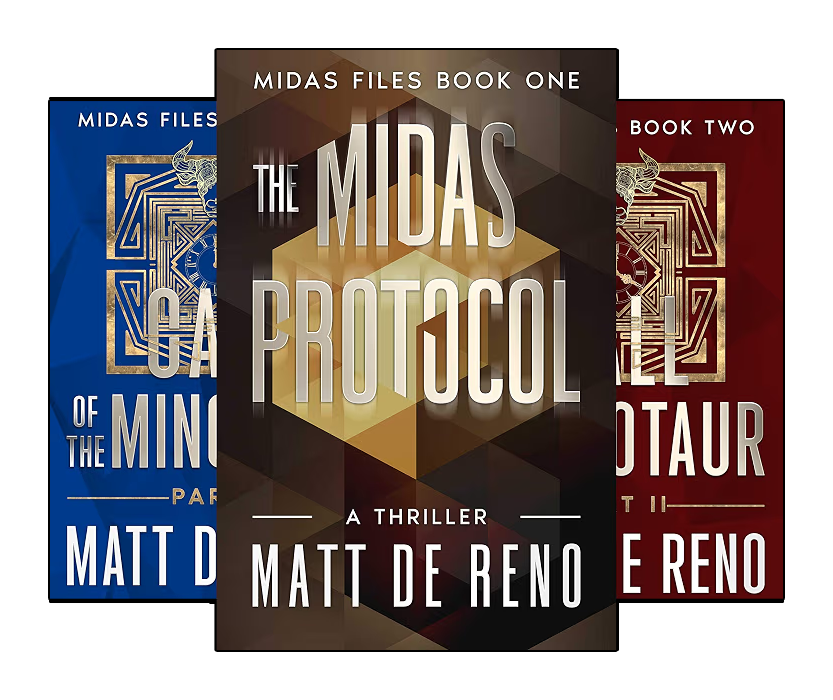

One of Hank Raglan’s favorite expressions in The Midas Protocol is, “Would that be a good thing or a bad thing?” Lately, I have found myself asking essentially the same question about artificial intelligence, particularly as I experiment with using it to expand the world of the Midas Files. My answer is increasingly that AI is neither inherently a good thing nor a bad thing. It is a tool, and like most tools, what comes out of it depends heavily upon the intent and skill of the person using it.
I recently watched a video from the Nerdy Novelist, a YouTube creator who spends a lot of time exploring AI tools for authors, and he made a point that stuck with me: if you are not particularly skilled at what you are trying to create, AI is probably going to amplify that weakness. If you already understand storytelling, imagery, music, video, communication, or even process improvement, however, AI can amplify those abilities too. That has become something of a guiding principle for me. The goal is not to press a button and ask a machine to be creative on my behalf. The goal is to use these new tools to extend creative skills I have spent most of my life developing.
Maybe my perspective is partly generational. As a Gen Xer who grew up reading Stephen King in the 1980s, I sometimes feel as though I have somehow stumbled into the golden age of creativity. When I was in eighth grade, getting a novel published seemed like something reserved for a rarefied group of people who had somehow crossed an almost mythical barrier into the publishing world. Writing appealed to me partly because it was one of the few creative mediums where money did not determine the size of your imagination. A writer has always possessed an unlimited special-effects budget.
If I wanted a UFO hovering over Pittsburgh, an ancient civilization buried beneath the desert, or reality itself folding in half, all I needed was enough imagination to describe it. Technology eventually opened another door. Five years ago, I experienced something that would have seemed nearly impossible to that eighth-grade version of me when I published my first novel on Amazon. Indie publishing allowed writers who might never have survived the old gatekeeping system to put professionally produced books into the hands of actual readers. AI now feels like another door opening.
For someone who has always imagined what it would be like to see his fictional world animated, dramatized, voiced, or brought to life on a screen, suddenly some of those possibilities are no longer confined entirely to fantasy. That does not mean everything produced with AI is automatically worthwhile. Far from it. We already have an excellent term for careless mass-produced material: AI slop.
If someone does not particularly care about the story, the image, the video, or the audience, having a machine generate more of it faster does not magically make it interesting. What excites me is almost the opposite. I can now take characters I have lived with for years and begin experimenting with ways to let them step outside the pages. Hank Raglan can appear in a short video and invite readers into a live reading. Characters can provide glimpses into the history and mythology behind the books.
A still image can become animated. I can create ridiculous little segments for The Funny Newz, experiment with voiceovers, or watch a UFO blow apart my supposedly safe Midas Files Mission Control studio because Mortimer Vanterpool has apparently decided my weekly YouTube broadcast presents an unacceptable security risk. None of those things replaces writing the books. If anything, they require me to know the books better. What would Hank actually say?
How would a character move? What does the Gold Box look like when it comes off the page? What visual language belongs to this universe? The technology may generate pixels, frames, or voices, but somebody still has to make creative decisions.
Perhaps that is why I hesitate when people describe AI as either the salvation or destruction of creativity. Both predictions give the technology too much credit. Human beings remain perfectly capable of producing terrible art without artificial intelligence, and they have been doing so enthusiastically for thousands of years. We have also repeatedly taken new technologies and turned them into creative mediums that earlier generations could barely imagine.
Photography did not eliminate painting. Movies did not eliminate novels. Digital publishing did not eliminate books. For storytellers who genuinely care about the craft, I suspect AI will become another collection of brushes, cameras, editing rooms, sound stages, and special-effects departments. The difference is that increasingly those tools can sit on the desk of one person. That does not guarantee good work. It does give someone with imagination and enough patience an extraordinary playground.
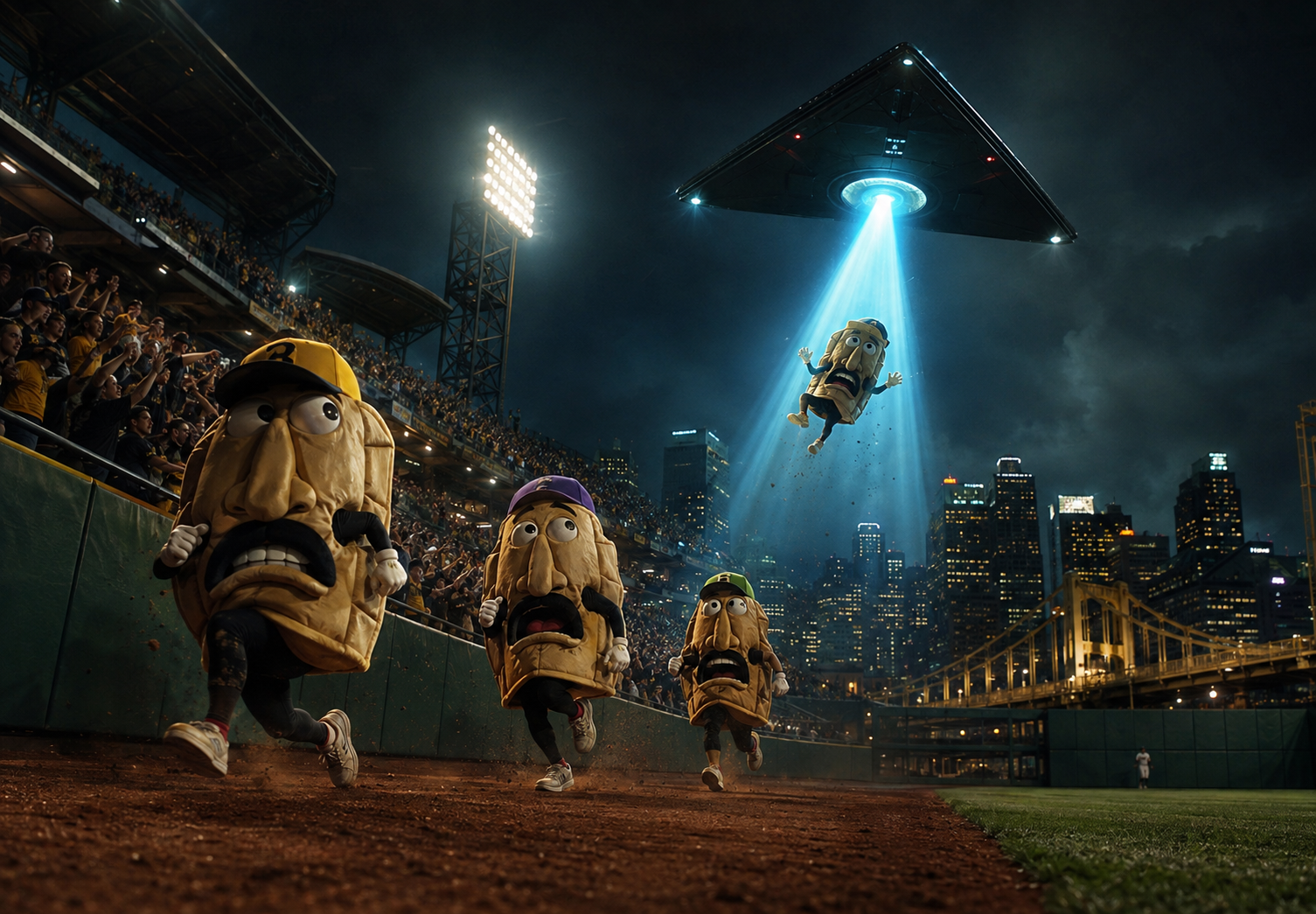
I received a small reminder of that recently while sitting in a luxury box at PNC Park watching the Pirates play the Red Sox. During the pierogi race, a friend who has apparently become far too familiar with the Midas Files asked whether Vanterpool was somehow going to destroy the ballpark. I laughed, but almost immediately my brain went to work. I could see the Obsidian Veil appearing over PNC Park while the pierogies continued racing, blissfully unaware that Vanterpool had arrived. One by one, a blue beam would lock onto them and pull them into the spacecraft until the final pierogi disappeared into the sky.
A few years ago, that would have remained nothing more than a ridiculous image in my head. Today, I could probably make it. So, would that be a good thing or a bad thing? I suppose that depends entirely upon your feelings about AI, storytelling, and the interdimensional abduction of racing pierogies. I am probably not going to think about it for very long.
About the Author
 Matt De Reno
Matt De Reno is the author of The Midas Files, a Pittsburgh-rooted science-fiction thriller series exploring UFOs, secret histories, ancient technology, and the occasional problem caused by reality folding in on itself. In The Scratching Post, he writes about the creative life behind the books—storytelling, indie publishing, AI experiments, live readings, works in progress, and whatever strange idea has wandered into his notebook that week. Email him at