
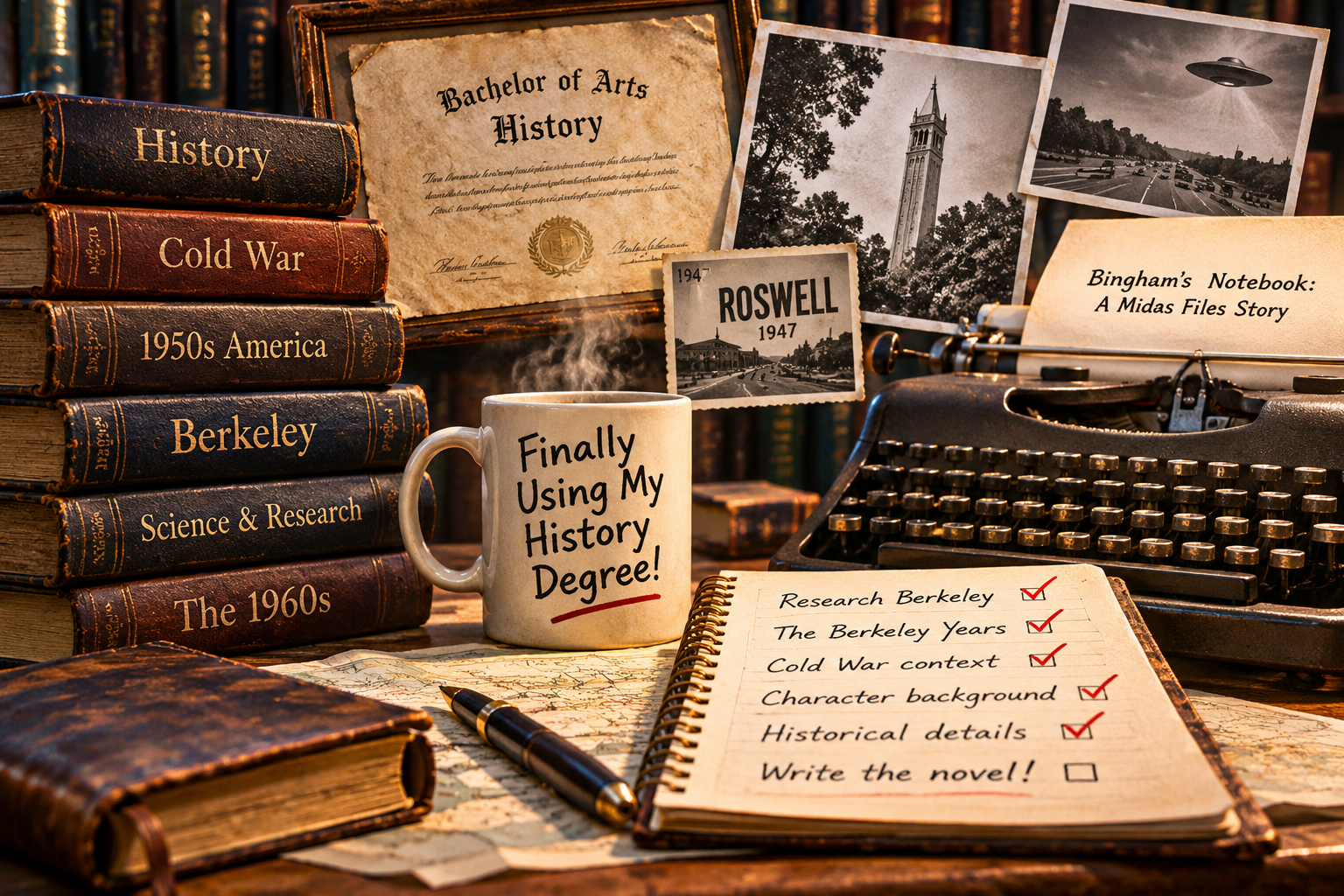
Well, it only took a few decades, but I'm happy to report that I'm finally putting my college history degree to good use.
Take that, everybody!
You see, back when I was in college, I decided to major in history. Why? Because I loved history. I loved learning about people, places, wars, politics, cultures, and all the strange twists and turns that brought us to where we are today. I found the whole subject endlessly fascinating, which seemed like a perfectly reasonable justification for spending four years studying it.
Apparently, that wasn't a particularly compelling career plan.
"What are you going to do with a history degree?" was a question I heard quite a bit. And to be fair, it was a reasonable question. I didn't have a particularly good answer. I wasn't planning to become a history teacher, I wasn't headed to law school, and as far as I could tell, there weren't a whole lot of companies advertising for someone who could explain the causes of the Peloponnesian War.
But I liked history, so I studied history. And now, all these years later, it's finally paying off.
Well, not financially. Good grief, let's not get carried away. But I'm using it!
Welcome to the Berkeley Years
Lately, I've been having an absolute blast developing my next novel, Bingham's Notebook: A Midas Files Story. The story begins in 1947, with the mysterious events surrounding Roswell, New Mexico, and gradually works its way through some of the most fascinating decades of American history. Along the way, I get to explore the early Cold War, the scientific ambitions of postwar America, and the cultural changes that would eventually transform the country during the 1960s.
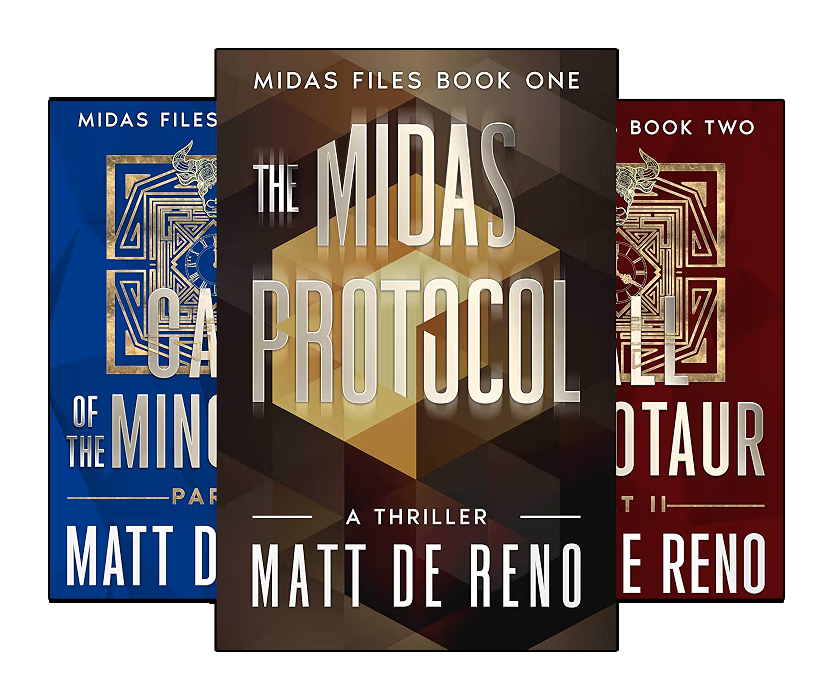
The first act of the novel is called The Berkeley Years, and it explores the lives of Lawrence Bingham, his wife Eva, and the brilliant but enigmatic Malcolm Kane. Readers familiar with The Midas Protocol and Call of the Minotaur already know that these characters will eventually become entangled in some rather extraordinary events. But one of the pleasures of writing this new book is getting to know them before their lives become so complicated.
I'm particularly interested in the people they were before the events that would ultimately define them. What were their ambitions? What did they believe about the world? What personal relationships shaped their decisions? And what might have happened differently if they had made other choices along the way?
Answering those questions requires more than simply inventing interesting characters. I want to understand the world they inhabited, particularly the intellectual and cultural environment surrounding the University of California, Berkeley, during the middle of the twentieth century.
What was campus life like? What were students studying? What did professors discuss over coffee? What scientific discoveries were capturing people's imaginations? What did an ambitious young researcher believe might be possible in an era when science seemed capable of changing nearly everything?
And perhaps most importantly, how did the events unfolding around these people influence the decisions they would make?
As it turns out, answering those questions has become one of my favorite parts of writing the novel.
Down the Historical Rabbit Hole
One minute I'm working on a scene involving Lawrence Bingham and Malcolm Kane. The next, I'm researching the history of Berkeley, Cold War politics, scientific research, student culture, or what everyday life looked like in the 1950s and 1960s. Inevitably, I stumble across some fascinating historical detail that sends me in an entirely different direction. Before I know it, I've spent an hour researching something I hadn't even intended to include in the novel.
The funny thing is, I'm enjoying every minute of it. It reminds me of the research I used to do in college, except now I'm doing it for the sheer pleasure of creating a fictional world. There's no exam to prepare for, no term paper to finish, and certainly no professor waiting to grade my work. I'm simply following my curiosity and seeing where it takes me.
Better still, the research often leads to unexpected discoveries that influence the story itself. A historical event might suggest a new scene, a detail about university life might reveal something about a character, or a scientific development might open up an entirely new narrative possibility. Sometimes I'll begin researching one subject and discover something entirely unrelated that turns out to be far more useful.
Of course, there's a danger in all this. I could probably spend the next six months researching Berkeley without writing another chapter. Anyone who knows me knows that I'm perfectly capable of disappearing down a rabbit hole and emerging three hours later with a wealth of fascinating information and absolutely nothing accomplished.
But I've also discovered that historical research can be a wonderful creative tool when it's connected to the story I'm trying to tell. I'm not merely collecting facts to sprinkle into the manuscript. I'm using what I learn to better understand the characters, their circumstances, and the choices available to them.
In that sense, history isn't simply providing the backdrop for Bingham's Notebook. It's helping me discover the story.
The Past Is a Pretty Good Place to Find a Story
One of the things I've always loved about history is that the people who lived through it didn't know how things were going to turn out. We have the benefit of hindsight, which makes it easy to forget how uncertain the future must have seemed to those experiencing events firsthand.
We know how the Cold War developed, how the cultural upheavals of the 1960s transformed American society, and which scientific discoveries would eventually change the world. But the people living through those decades didn't have that knowledge. They were making decisions based on their understanding of the world at the time, often without realizing how consequential those decisions might become.
That's an especially interesting idea to explore in a novel involving time travel, destiny, ambition, and the consequences of choices that may not become apparent until decades later. In Bingham's Notebook, I have the opportunity to follow characters who believe they're shaping their own futures, even as events unfold that will eventually lead them somewhere they could never have imagined.
Readers familiar with The Midas Files may recognize certain names, relationships, or historical circumstances and understand their significance long before the characters do. I find that possibility particularly appealing because it allows me to explore not only what happens, but how seemingly ordinary decisions can set extraordinary events in motion.
There's also something satisfying about discovering how much genuine history can enrich a fictional narrative. I don't need to invent an entirely new world when the real one provides so much fascinating material. Sometimes the challenge is simply deciding which historical details deserve a place in the story and which are better left in my research notes.
After all, I'm writing a thriller, not a history textbook. Although I suppose my old professors might appreciate the footnotes.
So, About That History Degree...
I suppose the moral of this little story is that you never really know when something you learned years ago might become useful. My history degree didn't lead me directly into a career as a historian, and it certainly didn't make me rich. I still haven't found anyone willing to pay me to discuss the Peloponnesian War, although I'm keeping my options open.
But studying history helped develop a curiosity about the past that has stayed with me throughout my life. It taught me to look beyond individual events and consider the people, circumstances, and competing ideas that shaped them. More importantly, it encouraged me to keep asking questions, which turns out to be a pretty useful habit for someone who enjoys writing fiction.
Now, decades later, I'm finding that same curiosity at work as I develop Bingham's Notebook. The more I learn about the historical world my characters inhabit, the more interesting those characters become. And the more interesting they become, the more excited I am to sit down and write.
There's something genuinely rewarding about that realization. I didn't study history because I thought it would someday help me write a science-fiction thriller involving time travel and secret government organizations. I studied it because I loved it. The fact that it's now contributing to something else I love doing feels like an unexpected bonus.
Perhaps that's the real value of an education. Not everything we learn needs to have an immediate practical application, and not every interest has to justify itself with a paycheck. Sometimes the things we're passionate about find their purpose in ways we couldn't possibly have anticipated.
So, to everyone who ever asked what I was going to do with that history degree, I finally have an answer.
I'm writing a novel. It's got time travel, secret government organizations, mysterious flying objects, and a few people who probably shouldn't be trusted with the future of humanity.
But the history? I'm taking that part seriously.
The story abides.
So What Can You Do With a History Degree?
Is a history degree worth it? What jobs can you get with a history degree, and how much do history majors earn? The answers might surprise you. According to 2024 U.S. Census Bureau data published by the Bureau of Labor Statistics, approximately 1.3 million employed Americans hold history degrees, earning a median annual wage of $72,000, just below the $73,000 median for workers across all college degree fields. History graduates work in education and libraries (18%), management (17%), law (11%), and business and finance (10%), among many other professions. Interestingly, 52% of employed history graduates hold an advanced degree, compared with 39% across all fields. Although interest in humanities degrees has declined since 2012, history remains a versatile foundation for careers requiring research, critical thinking, communication, and analytical skills. The American Historical Association also reports that history majors enjoy diverse career opportunities, with median lifetime earnings estimated at approximately $1.65 million in 2025 dollars. So, what can you do with a bachelor's degree in history? Apparently, quite a bit. You might become a lawyer, teacher, executive, researcher, journalist, or writer. Or, in my case, you might spend a few decades wondering what to do with it before discovering that it's pretty useful for writing historical science-fiction thrillers.
About the Author
 Matt De Reno
 is the author of The Midas Files, a Pittsburgh-rooted science-fiction thriller series exploring UFOs, secret histories, ancient technology, and the occasional problem caused by reality folding in on itself. In The Scratching Post, he writes about the creative life behind the books—storytelling, indie publishing, AI experiments, live readings, works in progress, and whatever strange idea has wandered into his notebook that week. Email him at