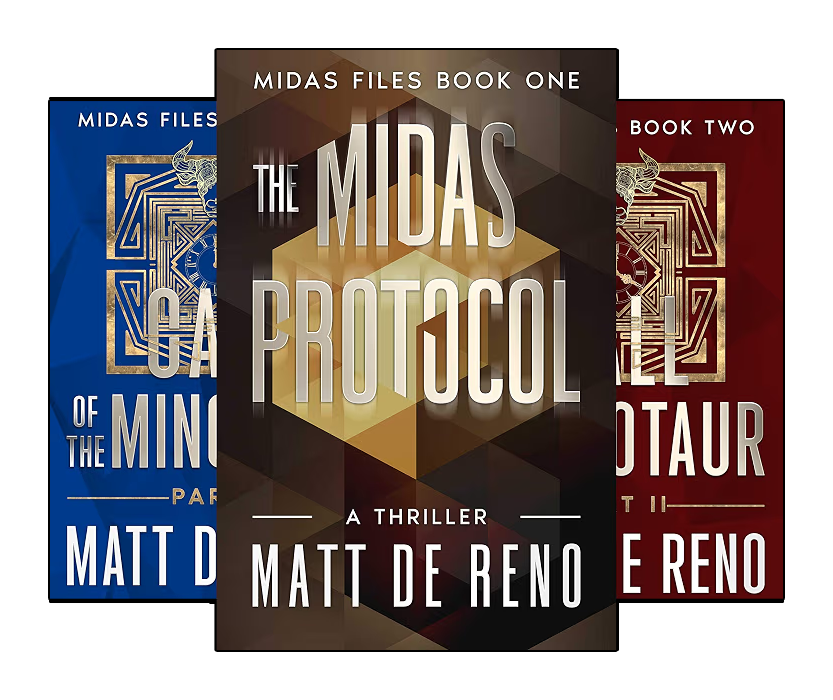

As I worked through the world of The Midas Files, I found myself creating characters whose traits sometimes echoed real political figures. Not direct copies. Not hidden biographies. More like creative composites — fictional people shaped by recognizable fragments of history, personality, ideology, and public image.
That fascinates me as a storyteller.
Political figures are larger-than-life by nature. They make decisions under pressure. They project confidence, conviction, ambition, charm, stubbornness, certainty, or moral contradiction. Whether we admire them, distrust them, or argue about them decades later, they tend to leave behind strong impressions. For a novelist, that kind of material can become useful story fuel.
In The Midas Files, I am not trying to recreate history exactly. I am trying to build a fictional world that feels close enough to reality to be believable, while still leaving room for ancient mysteries, hidden technologies, secret organizations, and alternate possibilities.
That is where politically inspired characters can be useful.
Fictional Characters With Real Echoes
One of the characters in The Midas Protocol is U.S. President James E. Hawthorne. He is not meant to be a one-to-one version of any real president, but he does carry echoes of more than one political figure.
When I imagined Hawthorne, I drew inspiration from both George W. Bush and Theodore Roosevelt. That combination gave me a character who could feel familiar without being trapped inside a single historical template. From one direction, there is a certain directness, swagger, and instinctive political confidence. From the other, there is force of personality, patriotism, and an almost mythic belief in American action.
Blending those influences allowed me to create someone who felt grounded in recognizable political energy while still belonging fully to the fictional world of The Midas Files.
That is the value of a hybrid character. The reader may sense something familiar, but the character is not limited by biography. He can serve the story.
Why Hybrid Characters Work
Using hybrid characters gives a novelist more freedom than placing a real historical figure directly into the plot. A real person comes with real history, real controversies, and real expectations. A fictional composite can borrow texture from reality while still developing in unexpected ways.
That matters in a story like The Midas Files, where the political world intersects with secret research, UFO lore, quantum technology, and otherworldly forces. The characters need to feel plausible, but they also need room to move.
A hybrid political figure can embody strengths and flaws from multiple sources. He can feel familiar enough to anchor the reader, but original enough to surprise them. That balance helps the story feel connected to our world without becoming a thinly disguised political commentary.
For me, the goal is not to make readers ask, “Who is this supposed to be?” The better question is, “Why does this person feel so real?”
The Fun of Alternate Possibilities
One of the pleasures of writing fiction is asking “what if?”
What if a president had to respond to knowledge the public could never be allowed to know? What if an administration inherited secrets from earlier eras? What if the Cold War, the space race, the rise of the internet, or the hidden machinery of government all had deeper layers beneath the official story?
Those kinds of questions are central to The Midas Files. The series lives in the space where history, conspiracy, science, and myth begin to overlap. Political characters help make that world feel bigger because they remind the reader that power does not exist in a vacuum.
Technology has consequences. Secrets have custodians. Decisions made in private can shape the lives of people who never know the truth.
That is fertile ground for a thriller.
President Hawthorne and the World of The Midas Files
One of my favorite small moments involving President Hawthorne comes in The Midas Protocol, when he grows irritated that Dr. Malcolm Kane and Bernie Heller are late for a meeting. The explanation is that they were busy working on something called the Internet — or, at that time, ARPANET.
That kind of line is fun because it places fictional characters near real technological history. It gives the story a sense that important things are happening just offstage. The public version of history continues, but inside the world of The Midas Files, there are deeper currents moving underneath it.
Hawthorne works best in that kind of space. He is a fictional president, but he exists in a world shaped by real history, real institutions, and recognizable political pressures. He allows the story to brush against reality without being confined by it.
The Line Between Inspiration and Imitation
There is always a balance to strike when drawing inspiration from real people. Too much resemblance, and a character can feel like parody. Too little, and the grounding disappears. The trick is to borrow energy, not identity.
A gesture. A worldview. A public style. A contradiction. A way of speaking. A sense of how someone might react under pressure.
Those elements can be transformed into fiction without turning the character into a caricature. That is especially important with political figures because readers bring their own opinions with them. The story works better when the character feels human, complicated, and useful to the plot rather than like a disguised argument.
In the end, I am less interested in writing “my version” of a real politician than in creating fictional people who feel as if they could have existed in the hidden corners of history.
Why This Matters to the Series
The Midas Files is built around the idea that the official story is never the whole story.
That does not mean every real event in the series needs a secret explanation. But it does mean the world of the books is shaped by the tension between what people know, what institutions hide, and what powerful individuals are willing to do when they believe history depends on them.
Political figures — even fictional ones — help sharpen that tension. They sit at the intersection of ambition, duty, ego, secrecy, and consequence. That makes them useful in a series where human ambition often collides with forces far beyond human control.
For me, that is where fiction becomes most interesting.
Not when it simply repeats reality, and not when it escapes reality entirely, but when it bends reality just enough to make readers wonder what else might be hidden beneath the surface.