
At first glance, Malcolm’s Coin appears to be nothing more than an elegant gold coin — the kind of trinket a wealthy academic, intelligence operative, or collector of forbidden antiquities might carry in a jacket pocket. That impression is dangerously incomplete.
The coin is not currency. It is not jewelry. It is not a stage prop, though Dr. Malcolm Kane uses it with the precision of a stage magician. It is a weapon disguised as a toy, a hypnotic instrument disguised as an antique, and one of Kane’s most intimate tools of control.
Within the hidden history of The Midas Files, Malcolm’s Coin represents a terrifying intersection of alien metallurgy, psychological warfare, hypnotic mastery, and Evium-based manipulation. It is small enough to vanish between Kane’s fingers, yet powerful enough to invade the mind of a victim and leave behind commands that can last for years.
The coin is believed to be of alien origin and composed partly of Evium Gold, the rare and reality-reactive material associated with some of the most dangerous artifacts recovered from the Archive of Enlil. Kane reportedly took the coin when the Archive was first recovered in the 1970s, removing it before its full properties could be cataloged, contained, or understood.
That theft may have seemed minor at the time.
It was not.
Physical Description
Malcolm’s Coin is deceptively beautiful.
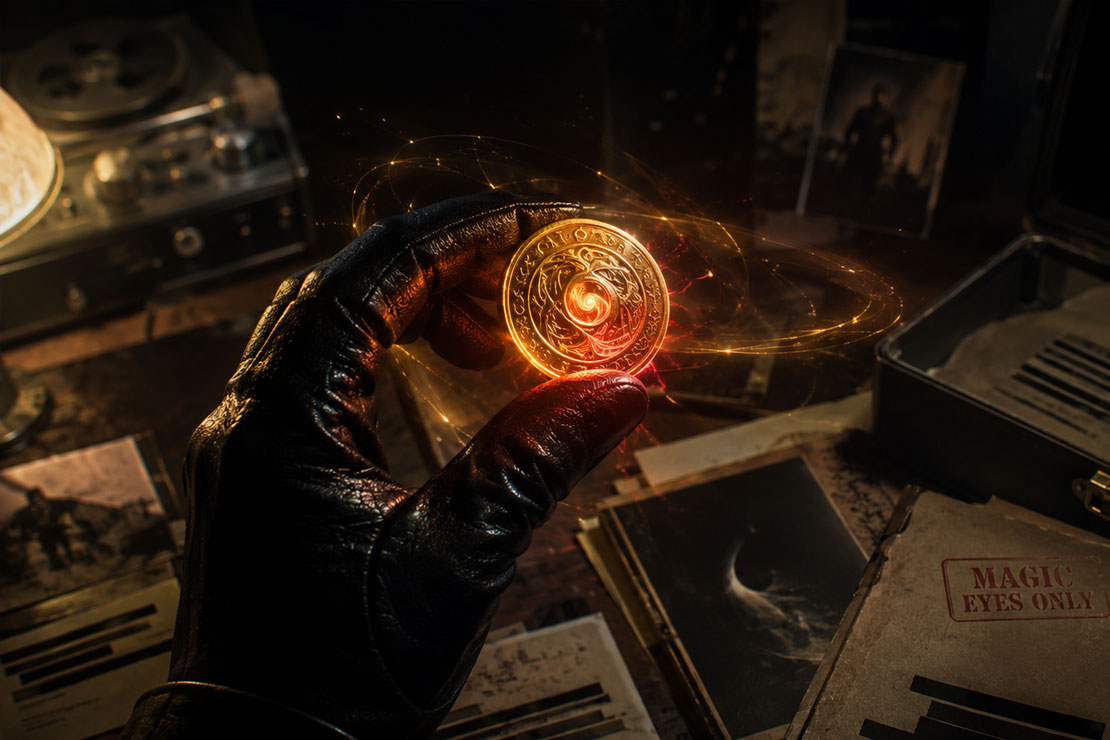
In ordinary light, it presents as a small gold coin, polished but ancient, with no obvious national markings, denomination, or conventional minting signature. Its surface is smooth at a distance, but under closer inspection it appears almost alive.
The gold does not simply reflect light. It seems to remember it.
Witnesses have described the surface as rippling with a faint inner luminescence, pulsing in slow, organic rhythms like a heartbeat seen beneath translucent skin. When Kane turns the coin between his fingers, shifting bands of amber and crimson move across it in patterns too fluid to be engraved and too intentional to be random.
The metal itself appears unstable in ways that violate conventional physics. It can seem hard and solid in one instant, then liquid in the next, flowing like mercury across Kane’s knuckles without ever losing its circular form. When spun or passed from finger to finger, it leaves thin trails of golden light suspended in the air, as though reality hesitates before allowing the coin’s movement to vanish.
Most unsettling are its gravitational properties. In Kane’s hand, the coin can appear briefly weightless, floating between his fingers before snapping back into his control. Whether this effect is produced by Evium-based field distortion, localized manipulation of perception, or Kane’s own psychological staging remains uncertain.
The practical distinction may not matter. To the victim, the coin floats. To the victim, the coin glows.To the victim, the coin becomes the only thing in the world.
Origins and Composition
According to Malcolm Kane, the coin was “forged from the heart of dying stars, shaped by hands that knew the secrets of creation itself.” As with most things Kane says, the statement should not be accepted at face value. Also as with most things Kane says, it should not be dismissed entirely.
The coin’s exact origin remains unknown, but its composition strongly suggests a connection to the same ancient nonhuman technologies later associated with the Archive of Enlil and the deeper Anunnaki inheritance threaded throughout The Midas Files. Its base material appears to include Evium Gold, though not in a form consistent with modern smelting, casting, or fabrication.
The coin may not have been manufactured so much as grown, tuned, or willed into form.
Its material properties suggest three overlapping characteristics:
- First, the coin responds to mental and emotional states. It does not behave identically for every handler, implying that its effects may be amplified by the user’s intention, discipline, and capacity for domination.
- Second, it appears linked to what some characters describe as the “metal of ancestors” — a phrase connected to Anunnaki heritage, hybrid bloodlines, and the ancient biological memory carried through certain families.
- Third, the coin exhibits localized quantum distortion. During use, it appears capable of bending perception, narrowing awareness, and altering the victim’s experience of space, time, and self.
In Kane’s hands, these properties become more than strange.
They become predatory.
Known Abilities
Hypnotic Induction
The coin’s most obvious function is hypnotic induction.
When moved in deliberate patterns, it generates mesmerizing visual effects: golden trails, shifting internal colors, and rhythmic pulses of light that draw the eye and hold it. Viewers report that the surrounding room seems to dim, while the coin becomes brighter and more defined.
This creates a tunnel-vision effect. Background sound fades. Peripheral awareness collapses. The victim’s consciousness narrows to a single point.
The coin.
The motion.
Kane’s voice.
Once that narrowing begins, resistance becomes increasingly difficult.
The coin does not merely distract the mind. It prepares the mind to be entered.
Neural Manipulation
The most dangerous property of Malcolm’s Coin is not its beauty, but what follows after the victim is entranced.
The artifact appears capable of helping Kane rewrite neural pathways with unnatural precision. It does not simply persuade. It imprints. Commands can be planted beneath ordinary consciousness, buried deep enough that the victim may later experience them as instinct, loyalty, fear, duty, or destiny.
Known forms of programming include obedience triggers, loyalty compulsion, emotional dependency, threat conditioning, and memory distortion.
The victim may not remember the full encounter. They may remember only fragments: the light, the warmth of Kane’s voice, the terrible feeling of something foreign moving behind their own thoughts. In some cases, the victim may form false memories around the event, allowing the mind to hide the violation from itself.
This is one reason the coin is so difficult to detect. Its damage does not always look like damage.
Sometimes it looks like devotion.
Reality Distortion
The coin also appears to affect reality in subtle but measurable ways.
Objects around it may seem farther away or closer than they should be. Time may appear to slow during induction. Sound may deepen, stretch, or vanish. Shadows may lengthen in directions that do not match available light sources.
Whether these are true physical effects or induced perceptual distortions remains unclear. However, given the known properties of Evium-based materials, it would be reckless to assume the effects are purely psychological.
With Malcolm’s Coin, perception and reality may not be separate categories.
They may be two sides of the same wound.
Usage and Technique
Malcolm Kane does not use the coin crudely.
He performs with it.
His technique combines sleight of hand, vocal modulation, timing, and environmental control. He moves the coin through elaborate geometries between his fingers, letting it vanish and reappear, float and fall, flash and dim. Every motion is calculated to draw attention where he wants it and remove attention from where the victim might still be free.
His voice is equally important. Kane lowers and softens his tone during induction, giving the impression of intimacy, safety, and inevitability. He does not shout commands. He places them carefully. He makes obedience feel like the natural conclusion of the moment.
Lighting also matters. Kane often uses shadow, isolation, and vulnerability to heighten the coin’s effect. A frightened child, a desperate young man, a grieving subordinate, or an ambitious recruit can all be made more susceptible under the proper conditions.
The coin is most effective when the victim is alone.
That is not incidental.
Kane prefers witnesses only when he already controls them.
Psychological Impact on Victims
Victims exposed to the coin may exhibit immediate physical symptoms: dilated pupils, slowed breathing, reduced voluntary movement, emotional flattening, or sudden stillness. Some appear awake but unreachable. Others enter a trance-like state in which they respond only to Kane’s voice.
More disturbing are the internal effects.
Victims describe the sensation of foreign thoughts entering the mind — not as loud commands, but as ideas that seem to slide into place with surgical confidence. The experience is invasive, intimate, and profoundly violating. The victim’s own mind becomes a locked room, and Kane enters with a key he has no right to possess.
Common long-term effects include unexplained loyalty to Kane or his causes, recurring fear responses, gaps in memory, compulsions triggered by phrases or situations, and emotional paralysis when attempting to disobey.
In the most severe cases, the victim does not merely follow Kane’s orders.
The victim begins to believe that obedience is part of who they are.
Known Victims
The most significant known victim of Malcolm’s Coin is Mory Vanterpool, later known as Mortimer Vanterpool.
Kane’s use of the coin on Mory represents one of the darkest examples of his methods. The act is not merely manipulation. It is the deliberate colonization of a young mind. Kane does not simply recruit Mory. He breaks into him. He installs obedience, fear, and devotion where freedom should have been.
Known or suspected programming phrases include:
“You will serve the Majestic Twelve.”
“I alone command your life and death.”
“When I speak, you will obey.”
Kane also weaponizes threats against loved ones, ensuring compliance not only through mental conditioning, but through terror. In this way, the coin becomes part of a larger system of control: artifact, voice, trauma, dependency, and blackmail working together.
The coin makes the door easier to open.
Kane still chooses to walk through it.
Limitations and Constraints
Despite its power, Malcolm’s Coin is not without limits.
The artifact appears to require close proximity and direct visual contact. Its strongest effects occur when the victim can see the coin clearly and hear Kane’s voice. Distance, interruption, darkness, or divided attention may reduce its effectiveness.
Strong-willed individuals may retain partial autonomy, especially if they understand what is happening or possess prior training against hypnosis, mental intrusion, or Evium-based influence. Even then, resistance is not guaranteed. The coin does not attack only through belief. It attacks through perception, fear, biology, and the hidden architecture of the mind.
Programming may also weaken over time without reinforcement, though deeply embedded commands can remain dormant for years before reactivating under the right conditions.
There may be detectable traces. Trained observers, especially those familiar with alien artifacts, dream-walk phenomena, or psychological conditioning, might recognize subtle “fingerprints” left behind by the coin: gaps in memory, obedience loops, emotional distortions, or implanted phrases that feel too clean, too sharp, too foreign.
But detection usually comes late.
By then, Kane has already gotten what he wanted.
Symbolic Significance
Malcolm’s Coin is one of the clearest symbols of Kane’s worldview.
It is beautiful, valuable, and ancient — and utterly corrupted by its use.
The coin represents false promise. It looks like treasure but delivers enslavement. It suggests wealth while stealing the one thing more precious than gold: free will.
It also represents the corruption of innocence. Kane’s use of the coin on children and young people reveals the true depth of his moral decay. He is not content to defeat enemies. He manufactures servants. He takes minds still in formation and bends them toward his own purposes.
In the larger mythology of The Midas Files, the coin also connects modern conspiracy to primordial darkness. The danger is not only that Kane possesses advanced technology. The danger is that ancient power has passed into the hands of a man who sees other human beings as instruments.
The coin is not evil because it exists.
It is evil because Malcolm Kane understands exactly what it can do — and uses it anyway.
Story Function
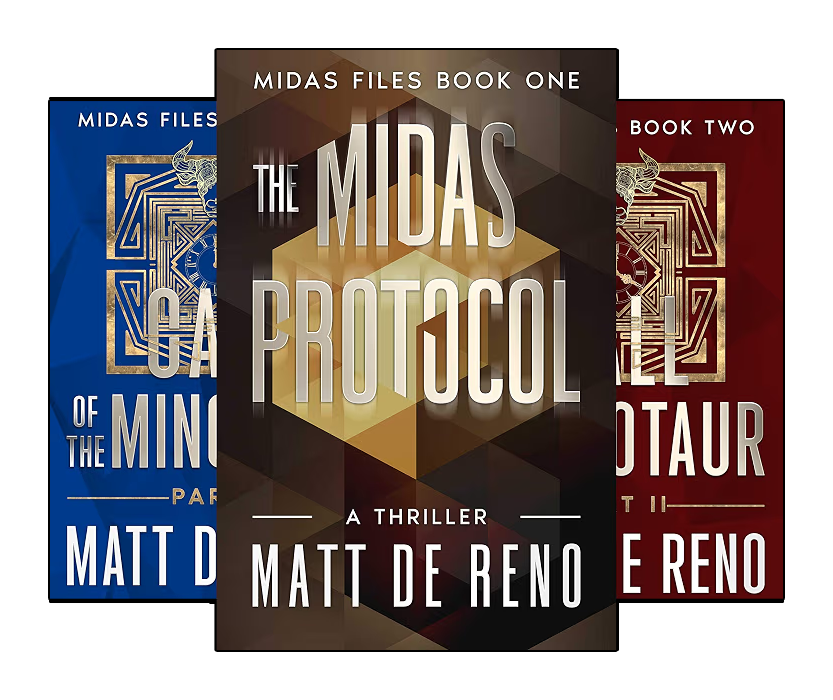
Within Call of the Minotaur, Malcolm’s Coin serves several key narrative functions. It reveals Kane’s true nature. Behind the intellect, polish, and rhetoric is a man willing to violate the mind itself in pursuit of power. It advances the plot by explaining how certain agents can be shaped, controlled, or conditioned across time.
It reinforces one of the central themes of The Midas Files: that power without restraint does not simply corrupt institutions. It corrupts the soul. Finally, it foreshadows the larger danger of alien artifacts in human hands. The coin is small. Portable. Concealable. Personal. That makes it more frightening, not less. A portal can destroy a city. A weapon can kill a body. Malcolm’s Coin can turn a person into someone else while leaving them alive enough to suffer the consequences.
Security and Concealment
Kane carries the coin in his jacket pocket, treating it with the casual intimacy of a favored instrument. Its harmless appearance is part of its danger. It can be carried through public spaces, handled during conversation, or displayed as a curiosity without raising alarm.
To the untrained eye, it is a coin. To Kane, it is a loaded weapon. To the victim, it may be the last thing they see before part of themselves disappears.
Closing Assessment
Malcolm’s Coin is not the largest artifact in The Midas Files. It is not the loudest, the most explosive, or the most visibly destructive.
But it may be one of the most intimate horrors in the series.
The coin embodies Malcolm Kane’s philosophy in miniature: that free will is negotiable, that weakness invites ownership, and that the strong are entitled to shape the lives of others. In his hands, beauty becomes bait. Wonder becomes leverage. Ancient power becomes a method of enslavement.
The coin glows like treasure. It moves like magic. It leaves behind obedience. And that is why it belongs in the deepest drawer of Bingham’s Notebook — stamped, sealed, and marked with the only warning that matters:
Do not look too long.
MAGIC EYES ONLY
Filed Under: Artifacts, Evium Technology, Majestic Twelve, Psychological Warfare
Related Figures: Dr. Malcolm Kane, Mortimer Vanterpool, Project Sovereign Eagle
First Major Appearance:Call of the Minotaur: The Midas Files — Book Two
Spoiler Advisory: This entry contains lore details connected to Call of the Minotaur.
CLASSIFICATION NOTICE
MAGIC EYES ONLY
Unauthorized review, duplication, transcription, psychic reconstruction, temporal recovery, dream-walk extraction, or post-event memory retrieval of this file is strictly prohibited.
Possession of this document implies clearance.
Clearance implies exposure.
Exposure implies liability.
Proceed accordingly.